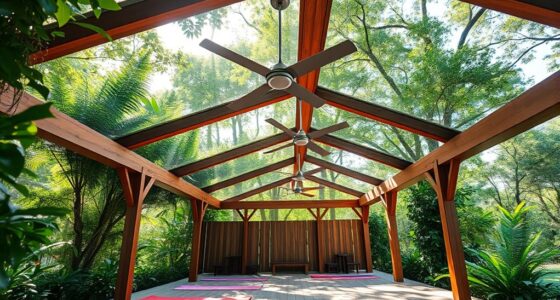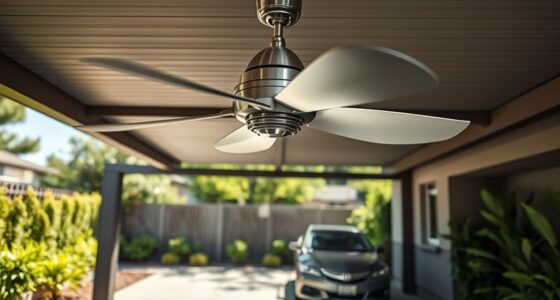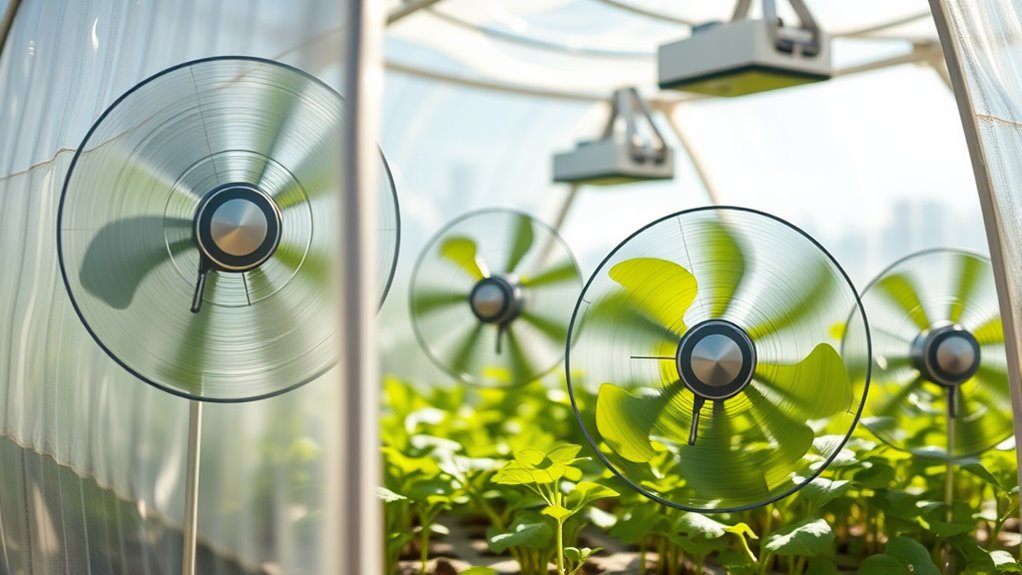
To maintain the right temperature in your pop-up greenhouse, use a combination of exhaust and intake fans to promote good airflow. Place exhaust fans near the top to remove hot, humid air and intake fans lower down to bring in cool air. Adding oscillating or ceiling fans helps distribute air evenly. Regularly check and adjust fan settings, and keeping them well-maintained guarantees ideal performance. Continue exploring to discover effective strategies for managing your greenhouse climate.
Key Takeaways
- Position exhaust fans near the ceiling to vent hot, humid air effectively.
- Use intake fans near vents or lower areas to bring in cooler outside air.
- Combine natural ventilation with mechanical fans for optimal airflow regulation.
- Select appropriately sized and energy-efficient fans based on greenhouse size.
- Regularly maintain and adjust fans to ensure consistent temperature control.
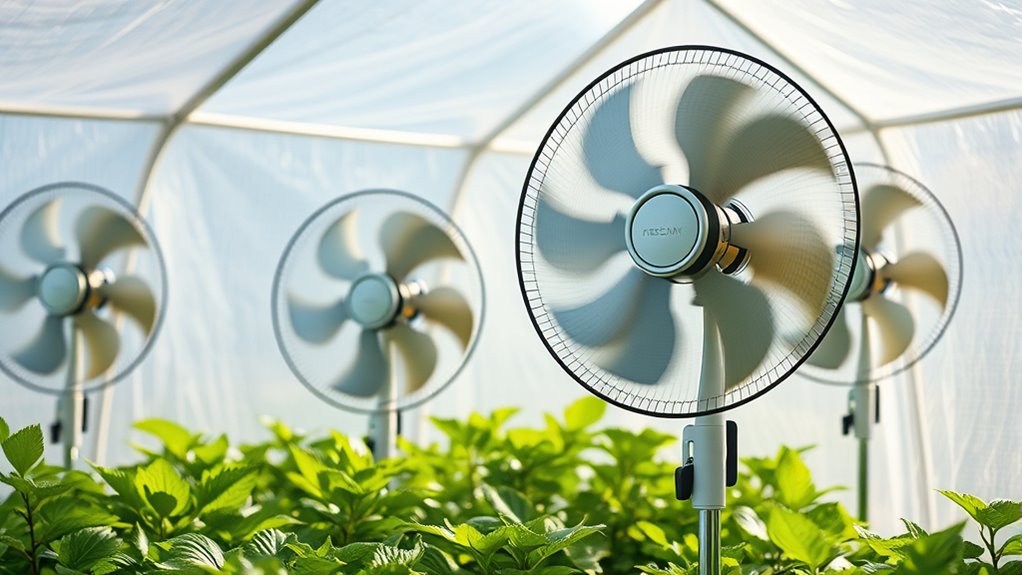
Fans play a essential role in maintaining healthy conditions inside pop-up greenhouses by ensuring proper airflow and temperature regulation. When you’re setting up your greenhouse, understanding ventilation strategies and fan placement becomes necessary to create an ideal environment for your plants. Proper ventilation helps prevent issues like overheating, excess humidity, and stagnant air, which can lead to diseases or poor growth. By carefully planning how you install your fans, you can maintain a stable climate that encourages healthy development.
Fans are crucial for healthy airflow and temperature control in pop-up greenhouses.
First, focus on your ventilation strategies. You want to establish a system that promotes continuous airflow to refresh the air inside your pop-up greenhouse. Natural ventilation, such as vents or windows, can be complemented with fans to enhance air movement during extreme weather or when natural airflow isn’t enough. Mechanical fans are particularly useful for actively circulating air, especially during hot days or humid conditions. You should consider using exhaust fans to remove warm, stale air and intake fans to bring in cooler, fresh air. Combining these creates a balanced environment, where temperature fluctuations are minimized, and humidity levels stay within suitable ranges.
Next, pay close attention to fan placement. Positioning your fans correctly is essential to maximizing their effectiveness. Typically, exhaust fans should be installed near the top of your greenhouse, where hot air tends to accumulate. This allows hot, humid air to escape efficiently. Conversely, intake fans should be placed lower or near vents to draw in cooler, fresh air from outside. If you’re using oscillating or ceiling fans, position them in areas that promote even air circulation throughout the space, avoiding dead zones where air might stagnate. Keep in mind that fans should be adjustable so you can fine-tune airflow based on weather conditions or plant needs.
Additionally, think about the size and power of your fans. Larger or more powerful fans can move more air and are suitable for bigger pop-up greenhouses, while smaller fans might suffice for compact setups. You also want to ensure that the fans operate quietly and efficiently, so they don’t disturb your environment or consume excessive energy. Regular maintenance, such as cleaning blades and checking electrical connections, keeps fans working at peak performance.

iLIVING 12" Wall Mounted Shutter Exhaust Fan, Automatic Shutter, with Thermostat and Variable Speed controller, 0.6A, 960 CFM, 1400 SQF Coverage Area Silver (ILG8SF12V-ST)
POWERFUL AIR VENTILATOR – 960 CFM, 115V, 0.6A, 1/20 Horse Power, 1650 RPM, Coverage up to 1400 square…
As an affiliate, we earn on qualifying purchases.
As an affiliate, we earn on qualifying purchases.
Frequently Asked Questions
How Do Fans Impact Humidity Levels in Pop-Up Greenhouses?
Fans impact humidity levels in pop-up greenhouses by improving air circulation, which helps control humidity. As fans move air around, they prevent moisture buildup and reduce excess humidity, creating a more stable environment. This air circulation ensures that humidity stays within ideal ranges for plant growth. You’ll find that using fans effectively manages humidity, reduces mold risks, and promotes healthy plants in your greenhouse.
Can Fans Be Used to Control Pests or Mold?
Fans can help with pest prevention and mold suppression by increasing airflow and reducing humidity, which makes conditions less favorable for pests and mold growth. You can use fans to create better air circulation, discouraging the buildup of moisture and pests. Regularly running fans guarantees your greenhouse stays dry and ventilated, effectively controlling pests and mold without the need for chemicals, and promoting healthier plant growth.
What Maintenance Is Required for Greenhouse Fans?
Think of your greenhouse fans as the engine of a well-tuned race car. You’ll need to regularly check fan blade maintenance to prevent dust buildup and guarantee smooth operation. Don’t forget motor lubrication to keep the motor running quietly and efficiently. Clean the fans and inspect components periodically, especially after heavy use or storms, to avoid unexpected breakdowns. Proper maintenance keeps your fans reliable and your greenhouse climate consistent.
Are There Specific Fan Types Best Suited for Pop-Up Greenhouses?
You should consider oscillating fans and inline fans for pop-up greenhouses. Oscillating fans are great because they evenly distribute air, preventing hot spots, while inline fans are efficient at moving large volumes of air, helping regulate temperature quickly. Both types are easy to install and maintain, making them ideal choices. Select based on your greenhouse size and airflow needs, ensuring ideal temperature control and healthy plant growth.
How Energy-Efficient Are Fans in Small-Scale Greenhouses?
Think of your greenhouse as a tiny, bustling city. Fans are like the city’s transportation, moving air efficiently. They’re quite energy-efficient, helping you manage energy consumption without breaking the bank. With proper use, fans can boost cost efficiency by reducing heating or cooling needs. This way, you keep your plants happy and your energy bills low, making your small-scale greenhouse a thriving, sustainable little metropolis.

Hurricane 16" Supreme Oscillating Wall Mount Fan w/ 3 Quiet Speeds, White – Corded Electric Air Cooling Unit w/ Easy Pull Cord Controls for Homes, Greenhouses, Garages, Workshops & Gyms
Space-Saving Cooling Fan: Maximize your floor space with this compact 16-inch wall mount fan for homes, greenhouses, garages,…
As an affiliate, we earn on qualifying purchases.
As an affiliate, we earn on qualifying purchases.
Conclusion
By using fans in your pop-up greenhouse, you’re giving your plants the gentle breath they need to thrive. Think of the fans as the heartbeat of your green space, keeping the environment alive and balanced. When you harness this simple tool, you’re not just controlling temperature—you’re nurturing a little ecosystem that blooms with health. With every breeze, you’re planting the seeds for a lush, vibrant garden that’s as resilient as it is beautiful.

Grow Tent Fan, 5in Two Fans for Greenhouse Plant All Direction Ventilation Circulation Instead of Oscillating, Can Work with Timer and Thermostat, 3 Speeds IP54 Waterproof 8ft Cord Power Adapter
New Way for Grow Tent Ventilation System: For most other grow tent fans, the main complaint is stop…
As an affiliate, we earn on qualifying purchases.
As an affiliate, we earn on qualifying purchases.

Amico 10" Shutter Exhaust Fan with Remote, 9-Speed Energy Efficient & Quiet 13W DC Motor 1000 CFM Wall Mount Ventilation Fan for Garage,Greenhouse,Attic & Chicken Coop,Plug & Play,8-Hour Timer,FCC
【Pays for Itself via 13W DC Motor】 Cut your utility bills by 76% compared to outdated AC models….
As an affiliate, we earn on qualifying purchases.
As an affiliate, we earn on qualifying purchases.