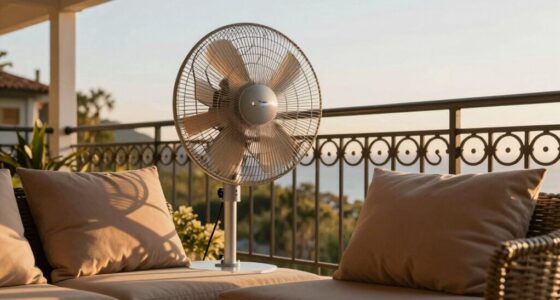

Choosing an outdoor patio fan comes down to whether you want cooling built into the space or the freedom to move airflow around. Outdoor ceiling fans mount overhead and can circulate air across a seating or dining area; outdoor pedestal fans stand on the floor and direct a breeze toward particular people or spots. The ceiling fan is usually the better fit for a covered patio used regularly, while a pedestal fan suits renters, open layouts and households that want to store the fan when it is not in use.

Get garden gear delivered free with Prime
- Fast, free delivery on millions of items
- Prime Video, Amazon Music and more included
- Member-only deals all year

iLiving 18-Inch Weatherproof Wall-Mounted Fan
- ✔ Fan diameter: 18 inches
- ✔ Airflow: 6,360 CFM
- ✔ Speeds: 3 pull-chain speeds

VEVOR 18-Inch Wall-Mount Fan, 3-Speed, 4150 CFM
- ✔ Fan diameter: 18 inches
- ✔ Airflow: Up to 4,150 CFM
- ✔ Speeds: 3

Depuley 52-Inch Ceiling Fan with Light and Remote, Black
- ✔ Blade span: 52 inches
- ✔ Blades: 3 lightweight plastic blades
- ✔ Motor: Pure copper DC motor
The practical tradeoff is permanence versus flexibility. A ceiling model can feel more integrated and keep the floor clear, but it needs a suitable mounting point and electrical installation. A pedestal model is simpler to position and often costs less to set up, but takes up floor space and may need to be moved or stored. In either case, check the product’s outdoor rating against the location: a covered patio and a rain-exposed area place different demands on the fan.
At a Glance
| Criteria | Outdoor ceiling fans | Outdoor pedestal fans | Winner |
|---|---|---|---|
| Installation and setup | Requires a secure overhead mounting point and typically electrical installation | Usually ready to position with minimal setup; needs a nearby power source | B |
| Airflow coverage | Circulates air across a fixed area from above | Directs airflow toward a targeted area or person | Depends |
| Placement flexibility | Fixed in one location | Easy to reposition and potentially store | B |
| Floor space and appearance | Keeps the floor clear and can look integrated | Uses floor space and may add visible cords or equipment | A |
| Weather suitability | Choose a model rated for its specific exposure; covered or damp locations differ from direct rain exposure | Must be protected and rated for the conditions where it will operate | Depends |
| Cost and value | Higher upfront installation costs can pay off with frequent, long-term use | Often lower initial setup cost; value is strong when portability matters | Depends |
iLiving 18-Inch Weatherproof Wall-Mounted Fan
For patios that need a substantial breeze across a broad area, the iLiving 18-Inch Weatherproof Fan has the clearest advantage in this group: its stated airflow reaches 6,360 CFM, compared with 4,150 CFM for the VEVOR. That difference makes it the strongest candidate when a seating area, greenhouse, or workshop feels stagnant and a targeted wall fan is practical. Its adjustable bracket helps aim the output where people are gathered instead of relying on general overhead circulation.The weatherproof description, corrosion-resistant finish, and sealed motor make this more patio-oriented than the Depuley ceiling fan, which must avoid direct rain. It is also a more powerful option than the VEVOR on paper. Buyers should still distinguish weatherproof construction from unrestricted exposure: the product information does not specify operating conditions for every kind of weather, so placement and installation guidance matter.This is a more industrial choice than the other two. The three speeds use a pull chain, which is straightforward but less convenient than the Depuley’s remote. Wall mounting is also required, and the compatible misting kit is sold separately. We would choose it for airflow and outdoor readiness, but skip it if a ceiling fan, integrated light, or remote operation is central to the plan.
Pros:
- Highest stated airflow in this comparison at 6,360 CFM
- Weatherproof design with a corrosion-resistant finish
- Adjustable wall bracket helps direct the breeze
- UL listed with an OSHA-approved safety grill
Cons:
- Requires wall mounting
- Misting kit is sold separately
- Pull-chain controls are less convenient than a remote
Best for: Patio owners who need high airflow from a wall-mounted fan and can install it securely.
Not ideal for: Shoppers who want a ceiling-mounted fan, remote controls, or a misting kit included.
Bottom line: We recommend the iLiving for patios where strong, targeted airflow and weather-oriented construction matter more than remote convenience.
“We recommend the iLiving for patios where strong, targeted airflow and weather-oriented construction matter more than remote convenience.”
VEVOR 18-Inch Wall-Mount Fan, 3-Speed, 4150 CFM
The VEVOR 18-Inch Wall-Mount Fan is a strong middle ground for a covered patio where buyers want meaningful airflow without stepping up to the iLiving’s higher output. Its up to 4,150 CFM rating and roughly 30-foot airflow reach suit a defined seating or work zone, while the adjustable tilt lets us point the breeze toward people rather than simply mounting the fan and accepting a fixed direction.Compared with the iLiving, the VEVOR gives up airflow but adds removable aluminum blades, a practical advantage when outdoor dust and debris call for cleaning. Its IP44 water-resistance rating also offers a concrete protection specification for covered spaces. That rating does not make it a rain-exposed fan, however; the product is not intended for exposed outdoor use. The Depuley has more speed settings and a light, but its ceiling-only format and direct-rain restriction make the VEVOR easier to aim at a patio zone.Installation deserves attention. The fan can mount to a wall or post, but the listing advises against installation on wooden walls. Buyers should identify an appropriate support before choosing it. Three speeds keep operation simple, though the provided information does not describe remote control. This pick suits people who value aimability and blade maintenance; those needing maximum stated airflow should choose the iLiving instead.
Pros:
- Up to 4,150 CFM with stated airflow reach of about 30 feet
- Adjustable tilt directs air toward a chosen area
- Removable aluminum blades simplify cleaning
- IP44 rating suits covered outdoor installations
Cons:
- Not intended for rain or exposed outdoor areas
- Installation on wooden walls is not recommended
- Lower stated airflow than the iLiving
Best for: People with a covered patio who want a directional wall fan with removable blades for cleaning.
Not ideal for: Buyers who need the highest airflow, want a fan for direct rain exposure, or plan to mount it on a wooden wall.
Bottom line: We would pick the VEVOR for a covered patio where adjustable direction and simpler blade cleaning matter more than maximum airflow.
“We would pick the VEVOR for a covered patio where adjustable direction and simpler blade cleaning matter more than maximum airflow.”
Depuley 52-Inch Ceiling Fan with Light and Remote, Black
The Depuley 52-Inch Ceiling Fan is the only overhead option in this roundup, so it makes sense for a covered patio designed around ceiling fixtures rather than a wall-mounted blast of air. Its three lightweight plastic blades, six speeds, and reversible DC motor offer more adjustment than the three-speed VEVOR and iLiving. The included LED light and remote also combine two functions above a dining or lounge area, and a two-hour timer and memory function simplify routine use.That convenience comes with stricter placement requirements. The fan is suitable for covered outdoor areas but must not be exposed directly to rain; it also works only on flat ceilings, unlike the wall-mounted alternatives, which can be aimed with a bracket or tilt. Its 52-inch span should be evaluated against the patio’s dimensions and mounting clearance. The provided specifications do not give an airflow rating, so buyers cannot compare its circulation output directly with the two CFM-rated wall fans.The 30 dB noise figure and six speeds make this model a more comfort-focused pick than the industrial iLiving, whose stated strength is high airflow. Two downrod lengths offer some installation flexibility, but they do not solve a sloped-ceiling fit. Choose the Depuley when overhead lighting, remote control, and year-round reversible airflow are priorities. Choose one of the wall fans if your patio needs a specified high-volume air stream or has no suitable flat ceiling.
Pros:
- Six speeds and reversible airflow support year-round use
- Integrated LED light adds overhead utility
- Remote includes timer and memory functions
- Quiet motor rated at 30 dB and two downrod options
Cons:
- Must be protected from direct rain
- Flat ceilings only; not suitable for angled ceilings
- No airflow rating is supplied for comparison with the wall fans
Best for: Owners of covered patios with flat ceilings who want overhead airflow, an integrated light, and remote operation.
Not ideal for: Anyone with an exposed or sloped ceiling, direct rain exposure, or a need to compare airflow by a stated CFM rating.
Bottom line: We recommend the Depuley when a covered, flat-ceiling patio needs a quiet fan and light in one fixture, rather than maximum measured airflow.
“We recommend the Depuley when a covered, flat-ceiling patio needs a quiet fan and light in one fixture, rather than maximum measured airflow.”
As an Amazon Associate we earn from qualifying purchases.
Key Differences
The first major difference is where the air goes. A ceiling fan stays overhead and moves air across a stable footprint, which works well when the same dining table or seating area needs regular cooling. A pedestal fan can be pointed toward a chair, shifted when guests rearrange the patio, or moved indoors when the weather changes. Neither format cools outdoor air like an air conditioner; both make people feel cooler by moving air across the skin.
Setup and ownership costs also favor different users. A pedestal fan generally avoids mounting work and is easier to replace or relocate. A ceiling fan can require a rated support, suitable wiring and professional installation, adding to its purchase price. That expense makes more sense when the patio is used often and the fixed coverage is useful throughout the season. Weather rating matters more than format: confirm that the particular fan is rated for the amount of moisture and exposure at its intended location.
For a permanent covered patio, the ceiling option usually makes a cleaner, less obstructive arrangement. For an uncovered or frequently reconfigured patio, a portable fan is easier to adapt, though it may need shelter or storage. Measure the area, consider the power source and check clearance before choosing; a fan that cannot be safely installed or protected is the wrong fit at any price.
Detailed Comparison
Installation and setup (Outdoor pedestal fans wins — moderate)
Pedestal fans usually win on setup, a moderate advantage for anyone who wants airflow without mounting work. Place the fan on a stable surface and connect it to power. A ceiling fan needs an appropriate overhead support and wiring, and installation may require a qualified electrician. That added effort is reasonable for a permanent patio, but burdensome for a temporary rental setup.
Airflow coverage (moderate difference)
This depends on the patio layout, so neither format wins for every space. A ceiling fan generally suits broad, consistent circulation over a fixed seating area. A pedestal fan wins for targeted airflow: its head can often be aimed at a particular seat, and oscillation can spread the breeze among nearby people. For a dining area used in one configuration, the ceiling fan often has the practical edge; for varied seating, the pedestal fan does.
Placement flexibility (Outdoor pedestal fans wins — major)
Pedestal fans win by a major margin. They can follow people between seating, dining and cooking areas, and some can be brought indoors or stored between uses. A ceiling fan remains where it was installed. Its fixed position is convenient when the same part of the patio needs regular airflow, but limiting when the layout or cooling needs change.
Floor space and appearance (Outdoor ceiling fans wins — moderate)
Ceiling fans win by a moderate margin for keeping the patio open. Mounted overhead, they leave walking paths clear and can appear integrated with the structure. Pedestal fans occupy floor space, which matters on compact patios, and their cord and stand may be visually prominent. The tradeoff is that an overhead fixture changes the appearance permanently, while the pedestal fan can be moved out of sight.
Weather suitability (major difference)
Neither format is automatically safer outdoors; the product rating and location decide. A ceiling fan under a roof may be protected from direct rain, but it still needs the appropriate rating for moisture and exposure. A pedestal fan may be easier to shelter or carry inside, yet should not be left in conditions its rating does not allow. This is a major practical check: match the manufacturer’s specified outdoor rating to the patio’s actual exposure.
Cost and value (moderate difference)
Pedestal fans usually cost less to get running because they avoid mounting and wiring work, giving them the edge for occasional use or a tight budget. Ceiling fans can be better value over years of frequent use when one fixed location needs dependable coverage and the installation cost is acceptable. Pay more for a ceiling fan if the permanence and clear floor are meaningful benefits; otherwise, the portable option is usually the economical choice.
Outdoor ceiling fans: Pros and Cons
Pros:
- Keeps floor space clear and avoids a stand in walkways
- Provides steady airflow over a fixed seating or dining zone
- Can look integrated with a covered patio
Cons:
- Needs suitable overhead support and installation
- Cannot be moved to follow changing seating or use
- Installation adds cost beyond the fan itself
Outdoor pedestal fans: Pros and Cons
Pros:
- Easy to position, aim and move as needs change
- Usually costs less to set up
- Can be stored or used in different locations when conditions allow
Cons:
- Takes up floor space and may create cord clutter
- Airflow is less integrated into the patio
- Must be protected or stored according to its weather rating
Who Should Choose What
Choose Outdoor ceiling fans if:
- Your patio is covered, has a suitable mounting point and is used often in a consistent layout.
- You want airflow over a dining or seating area while keeping the floor clear.
- You are comfortable paying for installation in exchange for a permanent fixture.
Choose Outdoor pedestal fans if:
- You rent or do not want electrical or mounting work.
- You want to aim the breeze at different seats or rearrange the patio often.
- You need a lower-cost option that can be moved or stored between uses.
Skip both if: Skip both if your patio has no safe power source or suitable weather protection for a fan rated for its exposure; address those constraints before buying.
Value for Money
A pedestal fan is better value for occasional cooling, flexible placement and low setup costs. It delivers the most useful airflow when you can position it near the people who need it, and you avoid paying for a permanent installation. A ceiling fan is worth the higher total cost when the patio is used frequently, its layout is stable and clearing the floor matters. The premium buys a fixed, integrated solution; it does not automatically mean stronger or more useful airflow for every patio.
Check the complete cost before deciding: the fan, any electrical work, mounting requirements and the means to protect or store it. A lower-priced fan that cannot safely handle the patio’s exposure is poor value. Choose the least costly format that fits the space and will be used regularly.
Final Verdict
For most people who want a simple, adaptable patio fan, choose an outdoor pedestal fan. It costs less to set up, can be aimed at the people who need cooling and can move when the layout changes. Choose an outdoor ceiling fan if you have a covered patio, a suitable mounting point and a stable seating area that needs airflow throughout the season. The deciding factor is permanence: pay for a fixed installation when you will use its clear floor and consistent coverage often. If neither fan can be placed and powered safely for the patio’s exposure, skip both until those conditions are addressed.
Frequently Asked Questions
Which is better for a small patio, a ceiling fan or a pedestal fan?
A ceiling fan is often a better fit when the patio has a safe overhead mounting point, because it keeps the floor clear. A pedestal fan is easier to try without installation, but its base can crowd a compact space. Check clearances and the fan’s coverage before buying.
Can an outdoor patio fan get rained on?
Only if the specific model is rated for the level of exposure at that location. Outdoor ratings vary; a fan suitable for a covered, damp patio may not be suitable for direct rain. Follow the manufacturer’s rating and guidance.
Does a ceiling fan cool an outdoor patio more effectively?
It can circulate air steadily across a fixed seating area, while a pedestal fan can concentrate airflow on a particular seat. Neither lowers the outdoor air temperature. The more effective choice depends on whether you need broad coverage or targeted airflow.
Is a ceiling patio fan worth the installation cost?
It can be worth paying for when the patio is used often, the layout stays consistent and keeping the floor clear matters. For occasional use, changing layouts or a rental, a pedestal fan usually offers better value because it avoids permanent installation.
Fall Picks
fall essentials
As an affiliate, we earn on qualifying purchases.