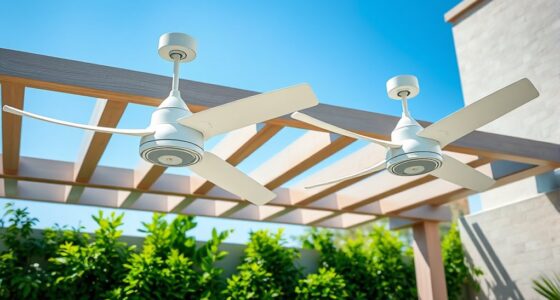
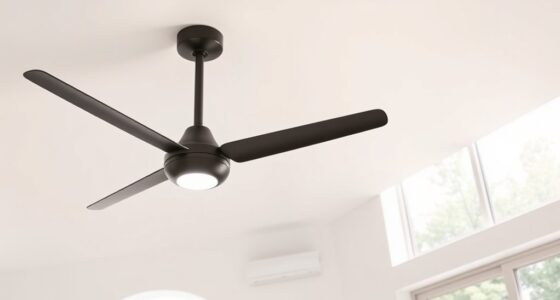
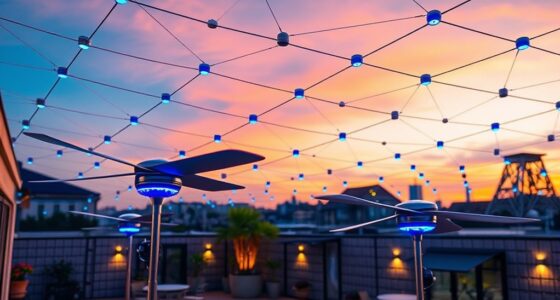
Smart fan blades use innovative technology to automatically adjust their angles based on room conditions, optimizing airflow and saving energy. Sensors detect changes like temperature, humidity, and occupancy, allowing the blades to fine-tune their pitch in real time. This not only improves comfort but also reduces power consumption and wear on the motor. By integrating with smart home systems, these fans become more responsive and efficient. Explore further to discover how this emerging tech can transform your space.
Key Takeaways
- Smart fan blades utilize sensors and adaptive control systems to automatically adjust blade angles for optimized airflow and energy efficiency.
- These blades respond in real-time to environmental factors like temperature and occupancy, improving comfort and reducing power consumption.
- Integration with smart home platforms enables users to schedule and control blade adjustments via apps or voice commands.
- Intelligent technology allows blades to operate at lower speeds while maintaining airflow, extending motor lifespan and reducing noise.
- Future advancements focus on more responsive, sustainable environments with automatic, real-time blade angle adjustments for smarter climate control.

Smart fan blades are revolutionizing how we stay comfortable by using intelligent technology to optimize airflow and energy efficiency. These innovative blades can adjust their angle automatically based on room conditions, ensuring you get the most effective cooling or heating with minimal energy use. By fine-tuning the blade pitch in real-time, they maximize airflow where you need it most and reduce unnecessary power consumption. This means you’ll experience consistent comfort without the waste associated with traditional fans that run at a fixed speed or rely on manual adjustments.
Smart fan blades automatically adjust to optimize airflow and energy use for consistent comfort.
When you consider airflow optimization, smart fan blades excel because they adapt in response to environmental changes. Sensors detect factors like room temperature, humidity, and occupancy levels. If a room warms up, the blades tilt to increase airflow directly toward you, providing a cooling breeze without having to run the fan at a high setting. Conversely, when the room cools down or no one’s around, the blades adjust to a more energy-efficient position, reducing power consumption. This dynamic adjustment not only enhances your comfort but also markedly cuts down on electricity bills over time. Additionally, adaptive control systems allow these fans to respond more precisely to changing conditions, further optimizing performance and energy savings.
Energy efficiency is at the core of these smart blades’ design. Traditional fans often operate at maximum capacity regardless of actual need, wasting energy and increasing costs. In contrast, intelligent blades measure real-time data to optimize their operation, ensuring they only use as much energy as necessary. This intelligent regulation allows for quieter operation and reduces wear and tear on the motor, extending the lifespan of the device. Plus, by intelligently controlling blade angles, these fans can operate at lower speeds while still delivering the desired airflow, further conserving energy.
Another advantage of smart fan blades is their ability to integrate with smart home systems. You can control and schedule them via apps or voice commands, allowing seamless adjustments based on your daily routines. For example, you might set the blades to optimize airflow before you arrive home, ensuring a comfortable environment upon your arrival without running the fan constantly. Over time, machine learning algorithms can even learn your preferences, automatically adjusting blade angles for ideal comfort and efficiency. Incorporating smart home integration makes these systems even more efficient and user-friendly.
In essence, smart fan blades are a step forward in creating smarter, more efficient living spaces. By focusing on airflow optimization and energy efficiency, they offer a practical solution that benefits both your comfort and your wallet. With automatic adjustments based on real-time data and integration into broader smart systems, these blades are transforming how we experience climate control, making our environments more responsive, sustainable, and cost-effective. Additionally, smart technology is continually advancing, promising even more innovative features in future fan designs.

DREO Smart Fan for Bedroom, 120° +120° Omni-Directional Oscillating Fans, 100ft Quiet Pedestal Fan with RGB Light, 9 Speeds, 6 Modes, 20dB, 8H Timer, Wi-Fi/Voice/Alexa, 35-40" Floor Fans with Remote
𝑾𝒉𝒐𝒍𝒆-𝒓𝒐𝒐𝒎 𝑨𝒊𝒓𝒇𝒍𝒐𝒘 𝑷𝒐𝒘𝒆𝒓: The DREO fan for bedroom delivers powerful airflow up to 100 ft with 1000 CFM….
As an affiliate, we earn on qualifying purchases.
As an affiliate, we earn on qualifying purchases.
Frequently Asked Questions
How Do Smart Fan Blades Improve Energy Efficiency?
Smart fan blades improve energy efficiency by optimizing blade design and adjusting angles automatically. You benefit from better airflow and reduced power consumption because the blades adapt to room conditions in real-time. This means you save energy while maintaining comfort. The smart technology guarantees the fan operates at peak efficiency, cutting down on energy use and lowering your utility bills, making your space more eco-friendly and cost-effective.
Are Smart Fan Blades Compatible With Existing HVAC Systems?
Smart fan blades can be compatible with your existing HVAC system, especially if they feature integrated control options and retrofit compatibility. You’ll want to verify if the blades can connect to your current control system and fit your existing fans without major modifications. Many manufacturers design these blades to easily integrate, so they can enhance your system’s efficiency without needing a complete overhaul. Just ensure compatibility before installation.
What Materials Are Used in Advanced Smart Fan Blades?
Advanced smart fan blades typically use lightweight, durable blade materials like high-strength plastics, composites, or aluminum alloys. These materials withstand frequent adjustments and environmental factors. Manufacturing techniques like precision molding, CNC machining, and lamination make certain of accuracy and smooth blade movement. By choosing the right blade material and employing innovative manufacturing methods, you can optimize performance, longevity, and energy efficiency in smart fan systems.
How Long Do Smart Fan Blades Typically Last?
You’ll be thrilled to hear that smart fan blades usually last about 10 to 15 years, assuming you don’t forget to perform their *luxurious* maintenance requirements. Their blade durability depends on materials used and environmental factors, but with proper care, you can enjoy their clever angle adjustments for years. Just don’t ignore the signs of wear, or you might find yourself replacing them sooner than expected—so much for “smart.”
Can Smart Fan Blades Be Controlled Remotely via Smartphones?
Yes, smart fan blades can be controlled remotely via smartphones. You’ll find many models offering seamless smartphone integration, allowing you to adjust speed, set timers, or change blade angles using a dedicated app. With a simple remote control or your device, you gain full control over your fan’s performance. This tech makes managing your fan more convenient, letting you customize airflow effortlessly from anywhere in your home.

Ohniyou Ceiling Fans with Lights, 52'' Low Profile Ceiling Fan with Light and Remote/APP Control, Modern Flush Mount Ceiling Fan for Indoor Bedroom Living Room, Dimmable, Quiet DC Motor, Black
Smart Ceiling Fans with APP & Remote Control: This modern ceiling fan with lights has all functions controllable…
As an affiliate, we earn on qualifying purchases.
As an affiliate, we earn on qualifying purchases.
Conclusion
With smart fan blades that adjust blade angles automatically, you could save up to 30% on energy bills each year. Imagine a fan that senses room temperature and modifies its blades for ideal airflow without you lifting a finger. This emerging technology isn’t just convenient; it’s a game-changer for energy efficiency. As more homes adopt these intelligent fans, you’ll enjoy cooler comfort while reducing your carbon footprint—making smart blades a smart choice for the future.
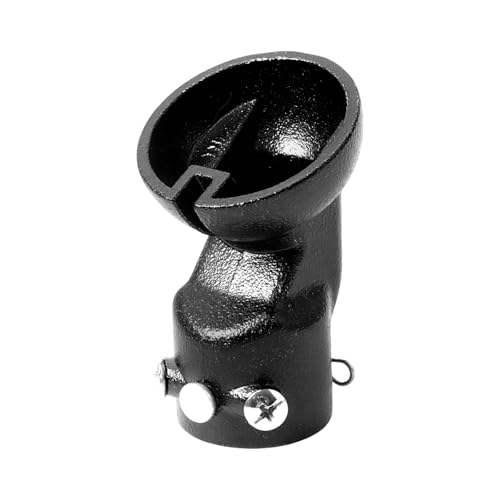
TEBTEOTEK Universal Sloped Ceiling Fan Adapter for Angled Ceiling Up to 45° (Black)
Slope Angeled (0°-45°): Install on various ceiling angles, from flat surfaces up to 45-degree slopes.
As an affiliate, we earn on qualifying purchases.
As an affiliate, we earn on qualifying purchases.

CINOTON Smart Ceiling Fan with Lights, 52'' RGBCW Ceiling Fan with Lights and Remote App Voice Control, Reversible DC Motor, 2600lm Dimmable, 6 Speeds & 2 Fan Modes, Quiet Fan for Bedroom, Living Room
Smart APP & Voice Remote Control: Compatible with Alexa, Google Assistant, and CINOTON apps, seamlessly integrate this smart…
As an affiliate, we earn on qualifying purchases.
As an affiliate, we earn on qualifying purchases.