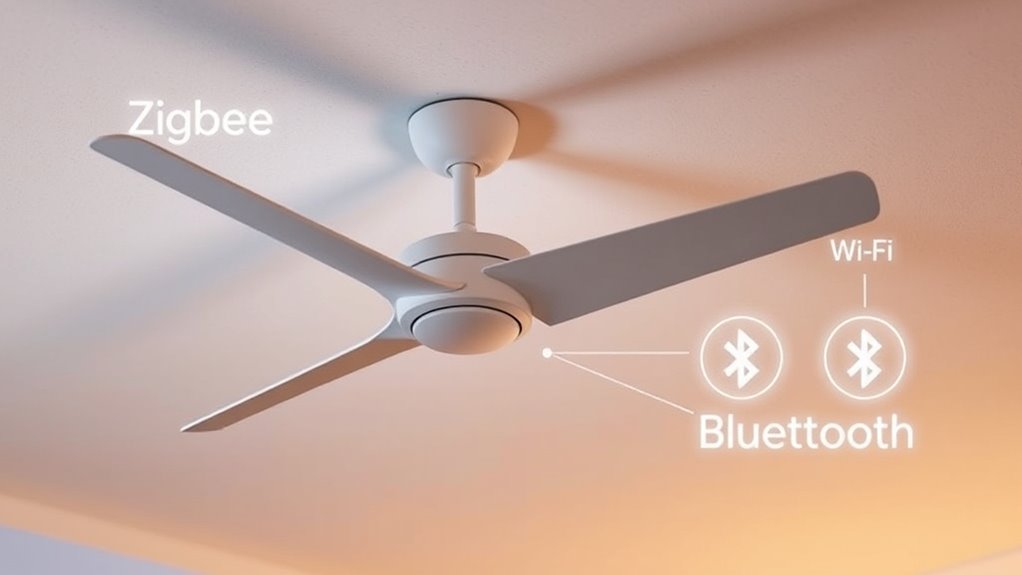

When choosing a protocol for your smart fan, consider your home setup and preferences. Zigbee offers reliable, low-power mesh networking great for stability and compatibility with ecosystems like Philips Hue. Wi-Fi provides faster connections and broad device compatibility, ideal if you want seamless voice control with Alexa or Google. Bluetooth is energy-efficient but better for close-range use. Exploring these options further will help you select the best fit and maximize your smart home’s potential.

Get garden gear delivered free — and shop member deals
- Fast, free delivery on millions of items
- Access to Prime Big Deal Days deals on October 6–7
- Prime Video, Amazon Music and more included
Key Takeaways
- Zigbee offers reliable mesh networking and low power consumption, ideal for seamless smart fan integration in existing ecosystems.
- Wi-Fi provides faster, broader compatibility with voice assistants like Alexa and Google for easier control.
- Bluetooth is energy-efficient but limited to short-range use, making it less suitable for remote or voice-controlled smart fans.
- Compatibility depends on your current smart home setup; Zigbee suits Zigbee hubs, Wi-Fi works with most routers and voice platforms.
- Future-proofing involves selecting protocols aligned with your ecosystem, ensuring easy scalability and long-term device support.
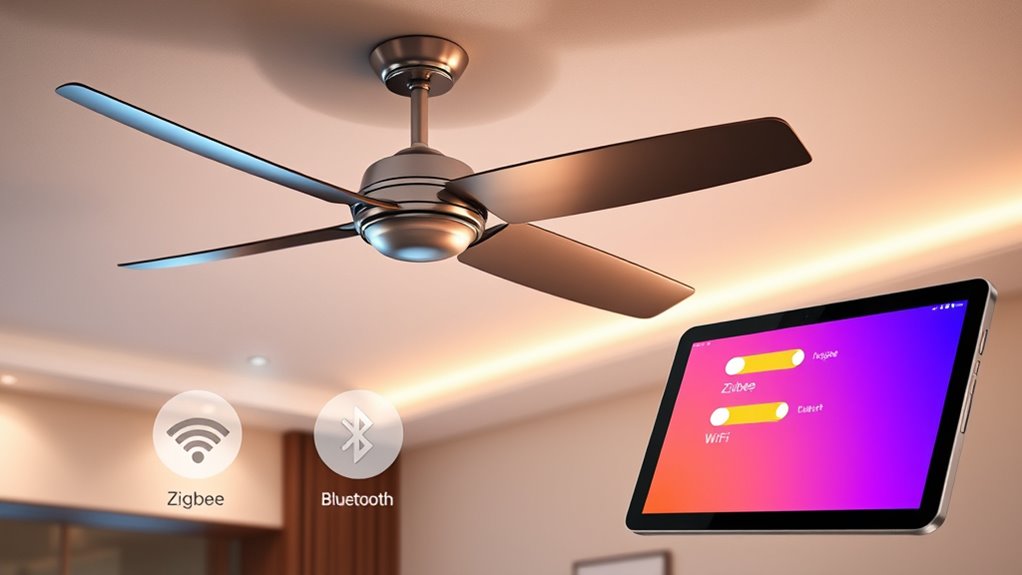
Ever wonder if your smart fan will work seamlessly with your existing smart home setup? The key to smooth integration depends heavily on the protocols it uses—Zigbee, Wi-Fi, or Bluetooth. Each protocol offers distinct advantages, and understanding these can help you make an informed choice. If you’re aiming for effortless voice control, compatibility with your voice assistant is vital. Zigbee and Wi-Fi are typically more reliable for voice commands because they connect directly to smart hubs or routers, ensuring quicker responses. Bluetooth, on the other hand, usually requires close proximity and isn’t as well-suited for voice control unless paired with a compatible device that acts as a bridge.
Choosing the right protocol ensures your smart fan integrates seamlessly with your smart home setup.
When considering energy efficiency, Zigbee shines. It’s designed specifically for low-power, IoT devices, meaning your smart fan can operate for extended periods without draining batteries or overloading your home’s power system. Wi-Fi-enabled fans tend to consume more energy since they constantly stay connected to your network, which might lead to higher electricity bills over time. Bluetooth, although energy-efficient for short-range communication, isn’t ideal for continuous operation or integration with smart home ecosystems, making it less suitable if you prioritize energy savings.
Your choice of protocol also impacts the overall reliability and responsiveness of your smart fan. Zigbee operates on a mesh network, allowing multiple devices to communicate directly with each other. This means even if one device drops out, your fan stays connected through other nodes, resulting in a more stable setup. Wi-Fi networks, while generally faster, can become congested with multiple devices, potentially causing delays in voice control commands or automation routines. Bluetooth’s limited range and point-to-point connection make it less dependable for controlling devices from across the room or house, especially if you’re integrating multiple smart devices.
Finally, think about your existing smart home ecosystem. If your home already uses Zigbee-based devices like Philips Hue or Samsung SmartThings, choosing a Zigbee-compatible fan makes sense. If your setup relies heavily on Wi-Fi devices and voice assistants like Alexa, Google Assistant, or Siri, a Wi-Fi-enabled smart fan will likely provide a more seamless experience. Compatibility, ease of setup, and future scalability all hinge on selecting the right protocol. Additionally, considering future-proofing your smart home ecosystem can help ensure your devices remain compatible as technology evolves. By considering voice control integration, energy efficiency, and your current smart home setup, you can choose a smart fan that truly enhances your home’s comfort and connectivity.
Frequently Asked Questions
Can Smart Fans Operate Without an Internet Connection?
Yes, smart fans can operate without an internet connection. With local control, you can manage your fan offline, guaranteeing smooth operation even during network outages. Many models support offline operation through physical controls or direct app connections via Bluetooth or Zigbee, allowing you to adjust settings without relying on Wi-Fi. This ensures continuous comfort and control, regardless of your internet status.
Which Protocol Offers the Best Energy Efficiency?
Oh, the irony—if you want the best energy efficiency, Zigbee is your friend. It’s designed for low power consumption, meaning your fan uses less energy and saves you money on power bills. Bluetooth isn’t far behind, but Wi-Fi tends to gobble up more power. So, if power savings matter most, Zigbee’s protocol offers the perfect balance of efficiency and smart control, helping you cut down on energy consumption effortlessly.
Are There Security Risks With Each Protocol?
Yes, each protocol carries security risks. Zigbee uses strong encryption standards, but vulnerabilities can occur if firmware isn’t updated regularly. Wi-Fi offers robust security with WPA3, yet it’s more exposed to network attacks if poorly managed. Bluetooth’s vulnerability management relies on secure pairing, but outdated versions may be susceptible to eavesdropping. Staying updated with the latest encryption standards and managing vulnerabilities helps minimize these risks across all protocols.
How Scalable Are These Protocols for Multiple Devices?
You’ll find that Zigbee excels in scalability due to its mesh network design, allowing you to connect many devices seamlessly. Wi-Fi can handle multiple devices but may face congestion as your network grows. Bluetooth is limited for larger setups but works well for smaller, direct connections. Protocol interoperability varies; Zigbee often integrates easily with other smart home systems, making it a flexible choice for expanding your device network.
Do Protocols Differ in Setup Complexity for Smart Fans?
Setting up your smart fan is like planting a seed—some protocols bloom with ease, while others need more tending. Zigbee often requires a hub, adding installation challenges, but it’s more user-friendly once set. Wi-Fi is straightforward, with minimal setup, making it ideal for quick installation. Bluetooth is the simplest, perfect for immediate use, but less suited for multi-device setups. Choose based on your comfort with tech and installation patience.
Conclusion
In the world of smart fans, choosing the right protocol is like picking the perfect dance partner—Zigbee, Wi-Fi, or Bluetooth—each has its own rhythm. Think of Zigbee as the quiet partner, quietly working behind the scenes. Wi-Fi is the lively partner, always connected and ready to impress. Bluetooth is the close companion, perfect for nearby interactions. Whichever you pick, you’ll orchestrate a seamless breeze that turns your space into a harmonious oasis.
Fall Picks
fall essentials
As an affiliate, we earn on qualifying purchases.