TL;DR
An Ideal Home report outlines six ways to combine garden security lighting with decorative design, including wall lights at entrances, motion sensors for darker areas and lighting built into patio heaters. The suggestions are practical design ideas, not evidence that lighting alone prevents crime; coverage, placement and safe installation matter.
Ideal Home has outlined six ways to use garden lighting for both appearance and security, challenging the assumption that protective outdoor lights must be stark floodlights. The report recommends lighting entrances and darker areas with a mix of wall lights, motion sensors and illuminated seating features, while noting that coverage and placement matter as much as brightness.

Get garden gear delivered free with Prime
- Fast, free delivery on millions of items
- Prime Video, Amazon Music and more included
- Member-only deals all year
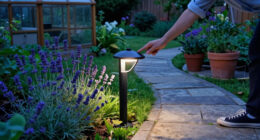
The report’s first suggestions focus on statement wall lights and the home’s entry points. Lantern-style and up-and-down fixtures can provide practical illumination while framing doors or garden walls. LightingLegends.com co-founder Jon Saeed says homeowners should think about driveways, side entrances and gardens, and consider how widely a fitting spreads its light rather than judging it by brightness alone.
For side gates, back doors, sheds and outbuildings, the report recommends motion-sensor lights, where activity triggers illumination. Saeed says these can suit places with less regular movement. The article gives one example of a lantern-style sensor light with a stated detection range of up to eight metres, but that figure applies to the named product, not all sensor lights.
The remaining ideas extend lighting beyond conventional wall fixtures: the article suggests integrated lights on patio heaters to brighten seating areas, and sets out decorative lighting approaches for the garden. Its overall point is to plan a layered scheme that improves visibility without relying on one powerful beam. The supplied source excerpt does not include the full descriptions of all six ideas, so the complete list cannot be verified here.
Lighting can make approaches, entrances and outdoor work areas easier to see after dark, while also making a garden more usable. The report’s recommendations direct attention to side gates, sheds and outbuildings, which may otherwise remain unlit, as well as the more obvious front and back doors.
That is a design and visibility argument, not proof that a particular fixture prevents burglaries. A well-lit area may help residents see activity and make outdoor cameras easier to use, but the article provides no crime data or measured evidence showing how much any lighting arrangement reduces risk. Lighting should be treated as one element of home security, not a guarantee.
Products Worth Considering

Orbit B-hyve 12-Zone Indoor/Outdoor Wi-Fi Sprinkler Controller

Greenworks 80V Cordless Leaf Blower with 2.5Ah Battery and Charger

IDEALHOUSE 8 × 10 ft Outdoor Polycarbonate Greenhouse
As an affiliate, we earn on qualifying purchases.
From Floodlights to Layered Design
The Ideal Home report responds to a familiar image of security lighting: a bright, cold floodlight. It argues that homeowners have other choices, including lanterns, wall washers and sensor fixtures that can fit a garden’s style. The piece frames these as practical design options rather than a new security technology.
Its expert comments emphasize different considerations. Lights4fun’s in-house lighting trends expert Claire Bassett recommends switch-operated lights with strong illumination, particularly where cameras are present. Saeed emphasizes broad coverage at entrances, while InstaShade’s Charles Irvine discusses lighting integrated into patio heating. Those are attributed professional recommendations; the source does not report a controlled comparison of products or security outcomes.
“For extra security and confidence, use switch-based lights with strong illumination – especially if you have cameras.”
— Claire Bassett, Lights4fun’s in-house lighting trends expert
Limits of the Security Evidence
The source offers design advice and expert views, but provides no independent crime statistics, controlled tests or comparison showing that the six approaches deter intruders. It also does not establish how much light is needed for a particular property, or whether a given layout will cover every vulnerable area.
The supplied article text ends during its fourth idea and does not show the full descriptions of the six promised approaches. Product performance can also vary by model and installation. Readers should check each fixture’s specifications, suitability for outdoor use and installation requirements rather than applying the example detection range to other products.
Plan Coverage Before Choosing Fixtures
The immediate next step for a homeowner is to map the areas that need visibility—such as doors, paths, gates and outbuildings—then select fixtures for the required spread and control. For any electrical work, use products rated for their location and follow manufacturer instructions; seek a qualified electrician where installation requires one. Do not assume decorative lighting alone provides comprehensive security.
The report does not announce a policy, product launch or forthcoming study. Its recommendations remain general design guidance, and further evidence would be needed to establish the crime-prevention effect of particular lighting choices.
Key Questions
What garden lights does the report recommend?
It discusses statement wall lights, lighting at entry points, motion-sensor fixtures and illuminated patio heaters, among other ideas. The supplied excerpt does not include the full details of all six suggestions.
Where should security lighting be placed?
The experts quoted recommend considering front and back doors, driveways, side entrances, gates, sheds and outbuildings. The report advises assessing how much area a light covers, not just its brightness.
Do motion-sensor lights prevent break-ins?
The article presents them as a way to illuminate darker areas when movement is detected. It does not provide evidence proving they prevent break-ins, so they should be viewed as one visibility measure, not a guarantee.
How far can a motion-sensor light detect movement?
The report cites one example with a stated range of up to eight metres. Detection range varies by product, so check the specifications for the particular model.
Source: idealhome.co.uk