
TL;DR
Two Cornell research papers examine the environmental and business sides of grazing sheep around solar panels. In a three-year field study, grazing at two sheep per hectare was associated with 38% more beneficial insects than mowing, while heavier stocking brought different vegetation-management results and a decline in honey bees at the highest rate tested. A separate spreadsheet model helps farmers plan flock size, costs and sales for solar-grazing operations.
Two Cornell research teams have published studies on sheep grazing at solar farms, reporting that stocking rates can affect beneficial insects and describing a planning tool for farmers managing flocks around solar panels. The work offers farmers and solar developers evidence about ecological trade-offs and a way to weigh flock, cost and contract decisions as the practice grows.

Get garden gear delivered free with Prime
- Fast, free delivery on millions of items
- Prime Video, Amazon Music and more included
- Member-only deals all year
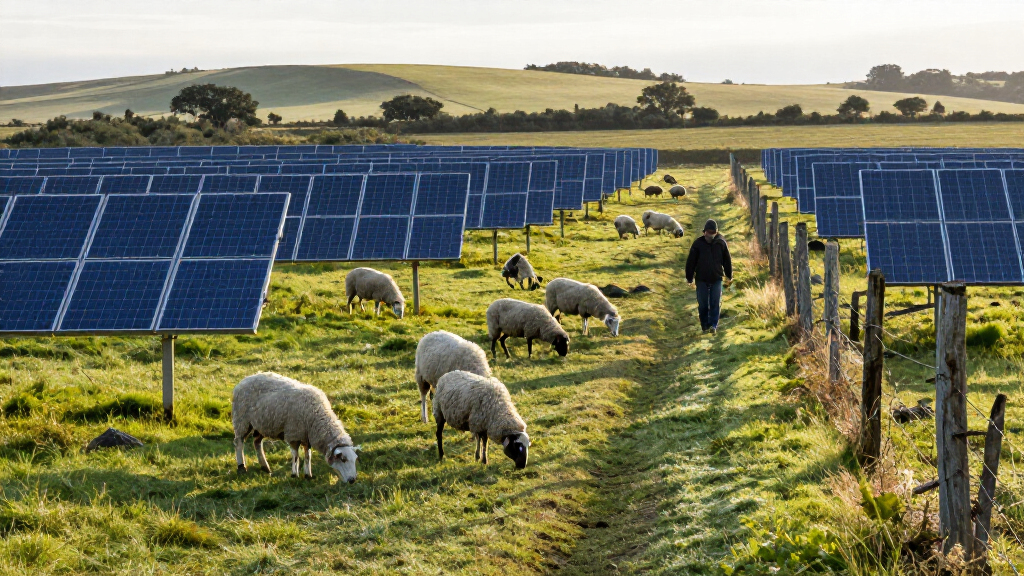
In a three-year trial at the university-owned Cascadilla Community Solar Farm in Dryden, New York, researchers tested different sheep stocking rates against a mowed control plot. At two sheep per hectare, the combined abundance of wild bees, honey bees and lady beetles was 38% higher than in the mowed plot. The researchers said the difference was driven primarily by an 83% increase in honey bees. The findings appeared Oct. 7 in Environmental Research Letters.
The results varied at higher stocking rates. At four sheep per hectare, beneficial insect abundance was similar to the mowed control, while vegetation management was more effective than at two sheep per hectare. At eight sheep per hectare, vegetation management was maximized and flock health remained high, but honey bee abundance was 45% lower than at the lower rate, according to the study. Those results describe the tested site and conditions, not a universal stocking prescription.
A separate paper, published Sept. 28 in Manufacturing & Service Operations Management, presents a spreadsheet-based decision tool for sheep farmers. It models procurement and sales decisions using factors such as target flock size, operating costs, expected revenue and vegetation at a specific solar site. It can also help solar developers understand farmers’ needs when developing grazing contracts. United Agrivoltaics has incorporated the model into its farmer onboarding process, according to Cornell.
Balancing Insects and Vegetation Control
The field study suggests that how many sheep graze a site matters for both vegetation control and insect abundance. Solar operators often need to manage plants growing around equipment, while farmers need grazing arrangements that work for their animals and businesses. The tested rates show these aims may not align at a single maximum stocking level: more sheep improved vegetation management in the trial, but the highest rate coincided with fewer honey bees.
For farmers, the business tool addresses a different constraint: maintaining enough animals to meet a site’s vegetation needs without buying or keeping more sheep than the operation can support. The model may help producers and developers discuss flock capacity, costs and contract terms using site-specific assumptions. It does not, by itself, establish that solar grazing will be profitable for every farm.
The research also gives municipalities and solar developers information to consider when evaluating land-use plans. The findings can inform discussions about combining energy production with agriculture, but they do not settle questions about how the results transfer to other climates, landscapes, plant communities or grazing systems.
Products Worth Considering

VEVOR Walk-In Tunnel Greenhouse with Watering System, 15 x 7 x 7 ft

Orbit B-hyve XR 8-Zone Indoor/Outdoor Smart Sprinkler Controller

EGO Power+ SNT2122 21-Inch Single-Stage Snow Blower with Two 4.0Ah Batteries and 320W Charger
As an affiliate, we earn on qualifying purchases.
Two Studies Address Separate Needs
Solar grazing, also called agrivoltaic grazing, uses sheep to manage vegetation beneath and around solar arrays. The practice brings together energy production and livestock farming on the same land. In the Cornell field study, researchers worked with university teaching sheep at the Cascadilla site and compared several stocking rates with a mowed area over three years.
The insect paper’s first author, Leana Zoller, is a postdoctoral associate in natural resources at Cornell’s College of Agriculture and Life Sciences. Senior author Steve Grodsky said the team focused on stocking rates because farmers use that measure in day-to-day decisions. The study involved researchers in entomology, ecology, animal science and plant science.
The business model grew from discussions between Cornell assistant professor Vincent Slaugh and sheep farmer Caleb Scott, founder of Ithaca-based United Agrivoltaics. Slaugh and co-authors Linwei Xin and Shane Henderson developed the tool to help farmers plan flock growth and help developers account for producer needs. Cornell also reported that about half of the lamb and mutton consumed in the United States is imported, primarily from New Zealand and Australia; that market figure provides economic context, but the paper does not establish that solar grazing will change national consumption or supply.
“We’re trying to understand the connections between those pieces so that when solar developers, municipalities looking at solar development, or farmers are faced with a decision, they can have scientific information about potential trade-offs and synergies.”
— Steve Grodsky, senior author of the insect study and Cornell assistant professor
Results Beyond the Trial Site
The insect findings come from one solar farm in Dryden, New York, and the source does not establish whether the same stocking rates would produce similar results at sites with different climates, vegetation, panel layouts or insect communities. The reported percentages compare specific trial treatments; they should not be read as guaranteed outcomes for other farms.
The source does not provide detailed measurements of the tool’s financial performance, such as typical changes in farm income or how results vary across contracts. It also does not report whether the model has been adopted by solar developers beyond its use in United Agrivoltaics’ onboarding process. The potential effects on domestic lamb supply and rural economies remain predictions, not findings from either paper.
Applying Findings to More Farms
Farmers and solar developers can use the published research to inform discussions about stocking rates, vegetation needs and grazing contracts, while accounting for conditions at each site. The spreadsheet tool is already part of United Agrivoltaics’ onboarding process, according to Cornell, but the source does not identify a broader rollout schedule or a planned date for additional evaluations.
Further evidence from other solar farms would help show how well the insect results apply elsewhere and how farmers fare financially under different contract and flock assumptions. For now, the Cornell papers provide one field trial and one planning model; broader ecological and commercial effects remain to be established.
Key Questions
What did the Cornell insect study find?
At the Dryden, New York, site, two sheep per hectare was associated with 38% more wild bees, honey bees and lady beetles combined than a mowed control plot. The reported increase was driven mainly by an 83% rise in honey bees.
Did more sheep always mean more beneficial insects?
No. At four sheep per hectare, beneficial insect abundance was similar to the mowed control. At eight sheep per hectare, vegetation management was maximized and flock health remained high, but honey bee abundance was 45% lower than at the lower rate, according to the study.
What does the flock-management tool do?
The spreadsheet-based model helps farmers weigh flock size, animal procurement and sales, costs, expected revenues and the vegetation needs of particular solar sites. It can also inform discussions between producers and solar developers about contracts.
Can the findings be applied to every solar farm?
The source reports a three-year trial at one New York solar farm. It does not establish that the insect outcomes or tested stocking rates will be the same at sites with different local conditions.
Source: news.cornell.edu