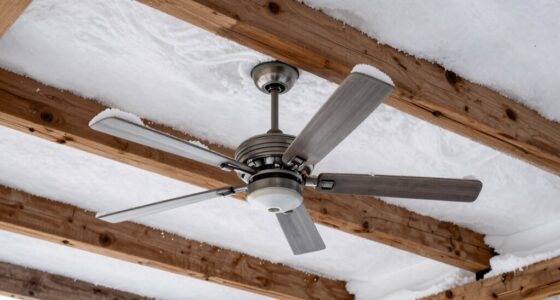
Shopping for an outdoor patio fan with a remote usually comes down to two different ways of moving air: a ceiling fan mounted above the seating area or a wall fan aimed across it. The ceiling option gives a more even breeze over a table or lounge set; the wall option directs airflow toward a chosen spot and avoids adding a fixture overhead. Neither style is automatically better. Choose a ceiling fan for an open, covered patio with a suitable ceiling and a preference for broad coverage. Choose a wall fan when the patio lacks a fan-rated ceiling, when airflow needs to reach one specific area, or when keeping the ceiling clear matters. Weather exposure, mounting, and the size of the area can matter more than the remote itself.

Get garden gear delivered free with Prime
- Fast, free delivery on millions of items
- Prime Video, Amazon Music and more included
- Member-only deals all year

56-Inch Outdoor Ceiling Fan with Light, IP66 Waterproof, DC Motor, Remote and App Control
- ✔ Blade span: 56 inches
- ✔ Airflow: Up to 9,000 CFM
- ✔ Weather rating: IP66

AHAWILL 20-Inch Outdoor Ceiling Fan with Light, Remote and App Control
- ✔ Fan diameter: 20 inches
- ✔ Blade span: 15.7 inches
- ✔ Water resistance: IP65

BOOSANT 60-Inch Outdoor Ceiling Fan with Light and Remote, 3 Walnut Wood Blades
- ✔ Blade span: 60 inches
- ✔ Airflow: Up to 7,202 CFM
- ✔ Blade material: Hand-finished walnut wood
At a Glance
| Criteria | Outdoor ceiling fans with remote | Outdoor wall-mount fans with remote | Winner |
|---|---|---|---|
| Airflow coverage | Broad, downward airflow over the area beneath the fan | Focused airflow across a smaller zone | A |
| Airflow direction | Covers the zone below; repositioning usually requires changing the fan installation | Can be aimed toward specific seats or a work area | B |
| Mounting and installation | Needs a suitable ceiling support and appropriate wiring | Needs a sturdy wall mount and a safe power connection | Depends |
| Weather exposure | Must be rated for the patio’s damp or wet exposure | Must be rated for the patio’s damp or wet exposure | Tie |
| Noise and comfort | Can feel even across a seating group when correctly sized and placed | Comfort depends on aim and distance; nearby users may feel a stronger breeze | A |
| Remote convenience | Often controls speed, light, and sometimes direction; features vary | Often offers speed control and may include oscillation; features vary | Tie |
| Value | Worth the cost when one ceiling fan can serve the main seating area | Can be better value when directed airflow solves the problem without ceiling work | Depends |
56-Inch Outdoor Ceiling Fan with Light, IP66 Waterproof, DC Motor, Remote and App Control
For a patio where airflow needs to reach beyond one chair or a small bistro set, this 56-inch fan is the most balanced pick in our lineup. Its listed airflow reaches 9,000 CFM, more than the BOOSANT’s stated 7,202 CFM, while its IP66 rating gives it the clearest stated weather-protection credentials among these three. Three ABS blades also suit a more exposed setting better than choosing a fan for appearance alone.Remote and app controls let us adjust six speeds, the dimmable 2,000-lumen light, and a timer from where we’re sitting. The reversible DC motor adds seasonal flexibility, and sleep wind mode gives it a gentler setting than the AHAWILL’s six-speed controls describe. That feature set makes it our best overall choice when we want one installation to cover airflow and patio lighting.There are still tradeoffs. This is a downrod-mounted ceiling fan, so installation depends on having a suitable mounting point and the necessary hardware; the product information estimates about 30 minutes for DIY installation. The noise specification is inconsistent, listing 30 dB in the description and 35 dB in the specs, so we wouldn’t rely on a single precise figure. Compared with AHAWILL, it needs more room and a more involved mount; compared with BOOSANT, it offers a higher listed airflow and app control, but not walnut blades.
Pros:
- 56-inch blade span and up to 9,000 CFM listed airflow
- IP66 rating and ABS blades for weather-exposed use
- Remote and app control with timer settings
- Dimmable 2,000-lumen light with three color temperatures
Cons:
- Listed noise figures conflict: 30 dB in the description and 35 dB in the specs
- Downrod mounting requires a suitable ceiling point and mounting hardware
- Larger span may be excessive for compact patios
Best for: Patio owners who need broad airflow, weather protection, lighting, and both app and remote controls.
Not ideal for: People with a small patio, no suitable downrod mounting point, or a strong preference for wood blades and quieter installation planning.
Bottom line: We’d start here for a larger patio because it combines the strongest stated airflow and weather rating with flexible controls.
“We’d start here for a larger patio because it combines the strongest stated airflow and weather rating with flexible controls.”
AHAWILL 20-Inch Outdoor Ceiling Fan with Light, Remote and App Control
AHAWILL takes a different approach: at 20 inches, it’s designed for a small patio zone rather than the broad sweep of the 56- or 60-inch fans. That makes it a more plausible fit above a compact seating area, where a large downrod fan could feel oversized. Its IP65 rating and included plug with a 2.2-meter cord also make the power setup more approachable when an outlet is conveniently placed.The remote and app offer a useful choice of controls, and the six speeds and three LED color temperatures make it easier to tune airflow and light to the moment. The larger 56-inch model is the better match for moving air across a substantial patio, but AHAWILL offers adjustability in a much smaller footprint. Its adjustable hanging height adds placement flexibility, although the listed recommended coverage of 15–30 m² should be considered alongside the modest 20-inch size rather than treated as proof of equivalent reach to a larger fan.The main compromise is scale: three blades and a compact span won’t provide the same broad circulation as the other two picks. It also needs to reach a power outlet, so the cord’s route and outdoor outlet location shape where it can go. Compared with BOOSANT, it avoids hardwiring and adds app control, but lacks the walnut finish and 60-inch span. We’d choose it for convenience in a smaller area, not as a substitute for a large ceiling fan over an expansive patio.
Pros:
- Compact 20-inch design suits smaller patio zones
- IP65 water resistance rating
- Remote and app controls with six speeds
- Plug and 2.2-meter cord avoid a hardwired power connection
Cons:
- Small span is less suited to broad patio coverage
- Placement depends on access to an outlet
- Listed size and recommended coverage may warrant checking against the specific layout
Best for: People furnishing a small patio or covered outdoor nook who want outlet power, app control, and adjustable lighting.
Not ideal for: Buyers who need wide-area airflow, have no nearby outlet, or want a large decorative ceiling fan.
Bottom line: We’d choose AHAWILL for a smaller outlet-accessible space where compact size matters more than maximum airflow.
“We’d choose AHAWILL for a smaller outlet-accessible space where compact size matters more than maximum airflow.”
BOOSANT 60-Inch Outdoor Ceiling Fan with Light and Remote, 3 Walnut Wood Blades
BOOSANT is the style-led choice in this comparison, with three hand-finished walnut wood blades on a 60-inch fan. Its broad span makes it a better physical fit for larger patio ceilings than AHAWILL, and the listed 7,202 CFM gives us a concrete airflow figure. That is substantial, though below the 56-inch fan’s stated 9,000 CFM. Buyers choosing between the two larger options should weigh BOOSANT’s wood finish against the other model’s higher listed airflow and IP66 rating.A quiet DC motor, six speeds, and an integrated dimmable LED with memory function cover the everyday controls. The included 5-, 10-, and 15-inch downrods offer more flexibility for different ceiling heights than the 56-inch pick’s supplied information specifies. This makes BOOSANT attractive when the fan needs to sit at a particular height while complementing a wood-toned outdoor room.Installation is the key limitation: this model is hardwired, so it isn’t the straightforward outlet-powered option AHAWILL offers. The maximum ceiling slope is 15°, and the supplied specifications don’t state an IP weather rating. That missing detail matters when comparing outdoor placement: we would verify the intended exposure and installation guidance before choosing it for an uncovered patio. It suits buyers who value walnut styling and can accommodate fixed wiring, but those prioritizing documented weather protection have a clearer specification in the IP66 fan.
Pros:
- 60-inch fan with hand-finished walnut wood blades
- DC motor and six speed settings
- Dimmable LED includes a memory function
- Three downrod lengths accommodate different ceiling heights
Cons:
- Requires hardwired installation
- Maximum ceiling slope is 15°
- Supplied specs do not state an IP weather rating
Best for: Buyers with suitable hardwired ceiling access who want walnut blades, adjustable downrod options, and integrated lighting.
Not ideal for: Anyone needing a plug-in setup, a ceiling slope above 15°, or a clearly stated IP rating for exposed placement.
Bottom line: We’d pick BOOSANT when walnut-blade appearance and downrod flexibility outweigh easier wiring and a stated IP rating.
“We’d pick BOOSANT when walnut-blade appearance and downrod flexibility outweigh easier wiring and a stated IP rating.”
As an Amazon Associate we earn from qualifying purchases.
Key Differences
The biggest difference is how the breeze reaches people. A ceiling fan distributes airflow over a broad area, which usually suits a covered patio used by several people at once. Its comfort depends on fan size, ceiling height, and placement: a fan that is too small or too far from the seating may leave still pockets. A wall fan concentrates airflow along a direction. That can be more useful for a narrow patio, a grill station, or a corner seating area, but people outside its path may feel little benefit.
Installation and exposure shape the decision as much as airflow. A ceiling fan requires a suitable overhead support and an outdoor rating matched to the patio’s exposure. A wall fan avoids ceiling mounting, but still needs a strong mounting surface, accessible power, and protection from weather appropriate to its rating. Remote controls add convenience to both styles, but functions differ by model; check whether the remote controls only speed or also light, oscillation, or reverse direction. Pay more for features that solve a real placement or comfort problem, not for a longer feature list alone.
Detailed Comparison
Airflow coverage (Outdoor ceiling fans with remote wins — moderate)
Outdoor ceiling fans generally win for broad coverage over a shared seating area. Air moves downward across the space beneath the blades, so several people can benefit without having the fan point directly at one seat. This is a moderate advantage on a covered patio with a table or lounge arrangement. A wall fan is better suited to a narrower zone; its airflow may be strong where aimed but weaker elsewhere. For a long or irregular patio, either style may need more than one fan, so check the manufacturer’s coverage guidance before buying.
Airflow direction (Outdoor wall-mount fans with remote wins — moderate)
A wall fan wins when the goal is to send air toward particular seats or a task area. Depending on its design, it may swivel or oscillate, letting users adjust the breeze without moving the mount. This is a moderate practical advantage for patios where furniture or activity is concentrated along one side. Ceiling fans provide a broad breeze below them, but are less adaptable after installation. If the seating arrangement changes often, a wall fan’s direction may be useful; if everyone gathers under one roofed area, the ceiling fan’s spread may matter more.
Mounting and installation (major difference)
Neither style wins for every patio, so this depends on the structure. A ceiling fan needs overhead support rated for a fan, suitable clearance, and appropriate wiring; an existing light box should not be assumed to support one. A wall fan needs a solid mounting surface and a practical power connection, but it can work where the overhead structure is unsuitable. The gap is major if one location lacks a safe mounting point: that constraint can decide the purchase before airflow features do. Confirm mounting instructions and electrical requirements for the specific model.
Weather exposure (major difference)
This is a tie between fan styles because the correct rating depends on the actual location, not whether the fan hangs from a ceiling or wall. A covered patio with limited moisture exposure may suit a damp-rated model, while a fan exposed to rain or frequent water needs a rating approved for that use. Check the manufacturer’s instructions for the fan, remote, and any included receiver. This is a major purchasing criterion: choosing a model without the right outdoor rating can make it unsuitable for the installation. Do not assume that a fan marketed for patios can be installed in any outdoor position.
Noise and comfort (Outdoor ceiling fans with remote wins — minor)
Ceiling fans have a modest edge for a shared seating area because their broad airflow can feel more even when the fan is correctly sized and installed. A wall fan can feel stronger up close or when aimed at one person, which some users appreciate and others find uncomfortable. This is a minor difference in general: comfort depends on speed, distance, blade design, and individual preference. Look for product details on noise and control settings, and consider whether you want a gentle background breeze or a more noticeable stream of air. Placement matters more than the category label.
Remote convenience (minor difference)
Neither style has a reliable category-wide advantage: remote functions vary by model. Both can let someone adjust speed from a seat, but a ceiling fan may also pair its remote with an integrated light, while a wall fan may offer oscillation or directional controls. The difference is minor unless a particular feature is important to your setup. Check what the remote actually operates, whether it is included, and whether the control system suits the installation. If the remote can be misplaced outdoors, a wall control or compatible replacement may be worth checking before purchase.
Value (moderate difference)
Value depends on what installation the patio already supports. A ceiling fan can justify a higher total cost when one unit provides comfortable airflow across the main seating area and the overhead wiring is ready. If installation requires structural work or new wiring, the added expense may outweigh the benefit. A wall fan can be better value when it solves a localized airflow problem with simpler mounting, though wiring work can still add cost. The gap is moderate and specific to the site: compare the complete installed cost and useful coverage, not just the listed fan price.
Outdoor ceiling fans with remote: Pros and Cons
Pros:
- Spreads a breeze across an open seating area.
- Keeps airflow centered over a table or lounge group.
- Some models combine fan and light controls in one remote.
Cons:
- Requires suitable overhead support, clearance, and wiring.
- Less adaptable if the seating layout changes.
- The wrong outdoor rating can make it unsuitable for the patio’s exposure.
Outdoor wall-mount fans with remote: Pros and Cons
Pros:
- Directs airflow toward selected seats or activity areas.
- Can suit patios without a suitable ceiling mounting point.
- Some models swivel or oscillate to cover adjacent spots.
Cons:
- Coverage is more focused and may miss people outside the airflow path.
- A nearby user may find the breeze too direct.
- Requires a solid wall mount and accessible power.
Who Should Choose What
Choose Outdoor ceiling fans with remote if:
- Your patio is covered and has a safe, fan-rated ceiling mounting point.
- Several people need a broad breeze over one table or lounge area.
- You want airflow from above and would also use an integrated fan light.
Choose Outdoor wall-mount fans with remote if:
- There is no suitable overhead mounting point.
- You need airflow directed toward a specific seating or work zone.
- You want to keep the ceiling clear or your patio layout is narrow.
Skip both if: Skip both if the patio has no suitable weather-rated mounting and power setup, or if you need to cool an exposed area where these fans cannot be installed safely. A portable outdoor-rated fan may fit better if your priority is movable airflow.
Value for Money
Paying more for a ceiling fan is worthwhile when it can serve the main covered seating area and the patio already has suitable support and wiring. In that case, broad coverage can make one well-placed fan more useful than a lower-priced wall model aimed at only part of the group. If ceiling work would substantially raise the installed cost, a wall fan may offer better value for a specific zone, provided its airflow reaches the people who need it. Compare the full cost of the fan, mounting, and electrical work, then pay extra only for features you will use, such as a light, oscillation, or more adjustable speeds.
Final Verdict
For a covered patio with a suitable ceiling and seating arranged beneath it, choose an outdoor ceiling fan with a remote. Its broader airflow is the better fit for keeping a group comfortable, and it can be worth paying more when installation is straightforward. Choose a wall-mount fan when overhead mounting is impractical or you need to aim a breeze at one specific zone. The deciding factor is the airflow pattern your patio needs, followed by safe mounting and the correct weather rating. If neither mounting location is suitable, skip both and consider a portable outdoor-rated fan.
Frequently Asked Questions
Are outdoor ceiling fans better than wall fans for a patio?
They are better for different layouts. A ceiling fan usually spreads air more broadly over seating below it; a wall fan aims air at a specific zone. Choose based on where people sit and which mounting location is suitable.
Can an outdoor patio fan be exposed to rain?
Only if the specific fan is rated for that exposure and installed as its manufacturer directs. Check the rating and instructions for the fan and its electrical components; a patio label alone does not mean every model is safe in an uncovered location.
Do both types of patio fan come with a remote?
Many do, but included controls and functions vary. Confirm whether the remote adjusts speed, light, oscillation, or other settings, and whether it is included with the exact model you plan to buy.
Is a wall fan a better value if my patio has no ceiling wiring?
It may be, especially if there is a safe wall mounting point and accessible power near the zone that needs airflow. Compare the full installation cost, since a wall fan may still require electrical work.