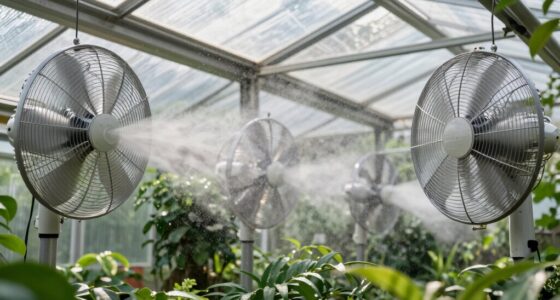
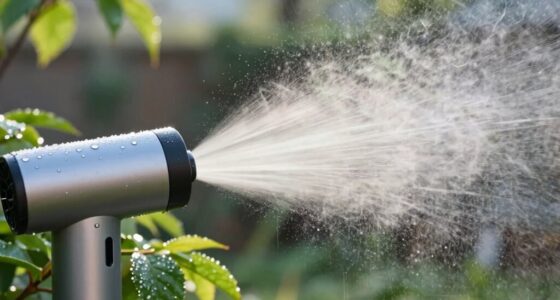
If your misting fan begins spitting instead of cooling, start by checking the water pressure; low pressure often causes uneven misting and spitting. Next, inspect and clean the nozzles, as mineral deposits or debris can block proper mist flow. Make sure hoses and fittings are secure and free of leaks, since leaks can disrupt pressure and flow. Addressing these issues first will likely solve the problem—keep going to learn more tips for peak performance.

Get garden gear delivered free with Prime
- Fast, free delivery on millions of items
- Prime Video, Amazon Music and more included
- Member-only deals all year
Key Takeaways
- Check water pressure and adjust with a regulator if necessary.
- Inspect and clean nozzles to remove mineral deposits or clogs.
- Ensure hoses and fittings are leak-free and properly connected.
- Verify steady water flow and fix any blockages or leaks.
- Perform regular maintenance on filters and nozzles to prevent future issues.

When your misting fan begins spitting water instead of providing a cool mist, it can be frustrating and counterproductive. The first thing you should check is the water pressure. If the pressure is too low, the fan may not produce a consistent mist, causing it to sputter or spit water. Most misting fans rely on a specific range of water pressure to operate correctly, so ensure your water supply meets those requirements. If the pressure is insufficient, you might notice irregular misting, which leads to water spitting instead of a fine, cool spray. Adjusting your water pressure or using a pressure regulator can often resolve this issue, restoring proper misting performance. Additionally, ensure that the water pressure stays within the optimal range specified by the manufacturer for best results.
Next, consider the nozzles, which are essential for creating the fine mist you expect from your fan. Over time, nozzles can become clogged with mineral deposits, dirt, or debris, especially if you have hard water. When nozzles clog, the water flow becomes uneven, and the misting process is disrupted, leading to splattering or spitting. You should inspect each nozzle carefully for any build-up or blockages. If you notice clogging, remove the nozzles and soak them in a vinegar solution or a descaling cleaner to dissolve mineral deposits. After cleaning, reinstall the nozzles and test the fan. Properly cleaned nozzles will produce a smooth, consistent mist, eliminating the spitting problem. Regular maintenance and nozzle cleaning can help prevent future clogs and ensure optimal performance. In addition, checking the water filtration system can help reduce mineral buildup and prolong the life of your nozzles.
It’s also worth checking the connection points and hoses for any leaks or damage. Sometimes, leaks can cause fluctuations in water pressure or air pockets, which contribute to inconsistent misting. Tighten any loose fittings and replace damaged hoses as needed to ensure a steady flow of water through the system.
misting fan water pressure regulator
As an affiliate, we earn on qualifying purchases.
As an affiliate, we earn on qualifying purchases.
Frequently Asked Questions
Can a Clogged Nozzle Cause Mist Spitting Issues?
Yes, a clogged nozzle can cause mist spitting issues. When there’s a nozzle blockage, it creates a misting obstruction, leading to uneven spray and spitting instead of smooth mist. To fix this, you should clean or clear the nozzle thoroughly. Regular maintenance helps prevent clogging, ensuring your misting fan operates correctly. Addressing nozzle blockage promptly restores proper misting, enhancing cooling efficiency and preventing further spitting problems.
Is Low Water Pressure Responsible for Mist Spitting?
Did you know that over 60% of misting fan issues stem from water flow problems? Low water pressure can definitely cause mist spitting, as inadequate flow prevents proper atomization. Check your water supply to guarantee consistent pressure, and verify your fan alignment—misalignment can cause uneven mist distribution. Improving water flow and aligning the fan properly often solves mist spitting, restoring your cooling experience efficiently.
How Often Should I Clean the Misting Fan?
You should clean your misting fan regularly—ideally once a month—to keep it working efficiently. Incorporate it into your maintenance checklist and follow troubleshooting tips to prevent issues like spitting. Regular cleaning removes mineral buildup and debris that can clog nozzles, ensuring proper misting and cooling. If the fan starts spitting, cleaning is often the first step to troubleshoot and restore peak performance.
Could Electrical Problems Lead to Mist Spitting?
Yes, electrical problems can cause your misting fan to spit instead of cool. You should start with electrical troubleshooting, checking for loose wires or faulty connections that might disrupt proper operation. Also, inspect fan components like the motor and control switch for damage or wear. Ensuring all electrical parts are secure and functioning correctly helps prevent spitting issues and keeps your fan cooling effectively.
Does Ambient Temperature Affect Misting Fan Performance?
Did you know that ambient temperature can drop misting fan efficiency by up to 30%? When temperatures rise, airflow efficiency decreases, making the fan less effective. You should check your fan’s positioning—placing it too close to walls or windows can hinder airflow. Adjusting the fan to optimize airflow and ensuring it’s not affected by ambient heat helps improve misting performance and prevents spitting.
As an affiliate, we earn on qualifying purchases.
Conclusion
When your misting fan begins spitting instead of cooling, think of it as a garden hose losing pressure—frustrating and ineffective. By checking the nozzles, water pressure, and filters, you’re clearing the path for a gentle, invigorating mist to flow smoothly like a cool breeze on a hot day. Fix these issues, and your fan will once again be a soothing cloud of coolness, turning your space into a revitalizing oasis amid the heat.
As an affiliate, we earn on qualifying purchases.
As an affiliate, we earn on qualifying purchases.
Fall yard work Picks
leaf blowers
As an affiliate, we earn on qualifying purchases.