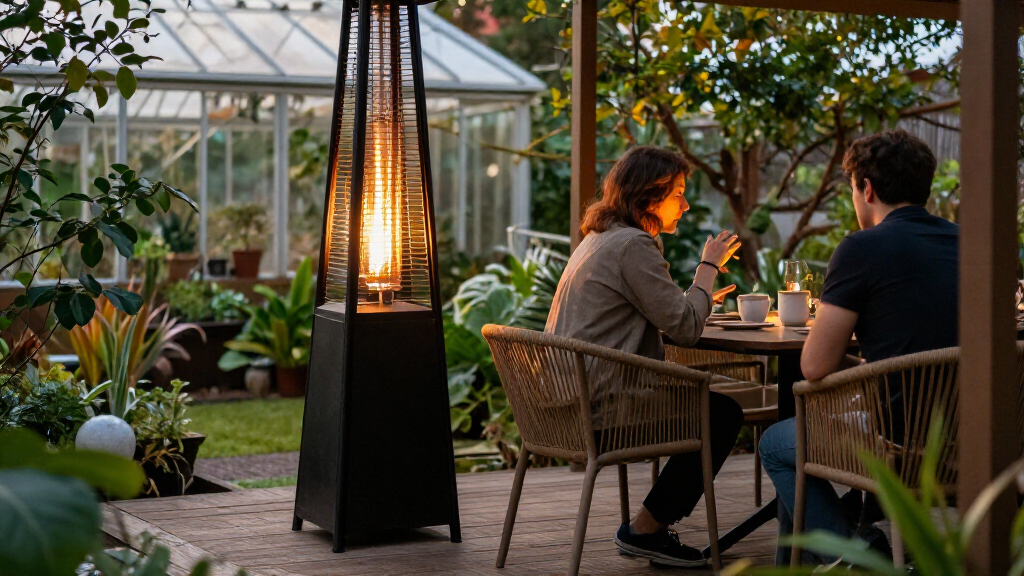
Choosing an outdoor patio heater comes down to how your space is arranged and how you plan to use it. Propane patio heaters can be moved around and provide strong heat without an electrical connection, but require fuel cylinders and routine handling. Electric heaters start with a switch and avoid on-site fuel, but need a suitable power source and work best where they can be installed or positioned near an outlet. For changing seating arrangements or open patios, propane is often the more practical choice. For a regular seating spot near power, electric can be easier to live with.

Get garden gear delivered free with Prime
- Fast, free delivery on millions of items
- Prime Video, Amazon Music and more included
- Member-only deals all year

Ciays 50,000 BTU Outdoor Patio Heater with Wheels
- ✔ Fuel: Propane
- ✔ Heat output: 50,000 BTU
- ✔ Coverage: Up to 18 ft

Sweetcrispy 48,000 BTU Propane Patio Heater with Wheels and Table
- ✔ Model: SW-JRQ-PT01-BN
- ✔ Fuel and heating method: Propane; radiant
- ✔ Heat output: 48,000 BTU

Hykolity 50,000 BTU Propane Patio Heater with Wheels, Silver
- ✔ Model: WHC-0322
- ✔ Fuel: Propane
- ✔ Heat output: 50,000 BTU
At a Glance
| Criteria | Propane patio heaters | Electric patio heaters | Winner |
|---|---|---|---|
| Placement and installation | Portable models need no outlet; cylinders must be stored and replaced. | Requires an outlet and suitable circuit; wall or ceiling models need installation and a suitable mounting point. | Depends |
| Heat delivery | Radiant heat can warm nearby people over a broad area; effectiveness falls with distance and wind. | Infrared models warm people and surfaces in their path; coverage depends on wattage, mounting, and exposure. | Depends |
| Convenience and maintenance | Requires cylinder checks, refills or exchanges, and safe storage. | Simple switch-on operation; no fuel cylinders, though electrical components need inspection. | B |
| Running costs | Depends on local propane prices, heater efficiency, and usage. | Depends on electricity rates, wattage, and hours of use. | Depends |
| Safety and ventilation | Combustion requires outdoor use and clearance from people, structures, and overhead surfaces. | No combustion at the heater, but electrical safety, clearances, and outdoor-rated equipment still matter. | B |
| Weather and outdoor suitability | Wind can carry heat away; many models need a stable base and protection from harsh weather. | Wind may affect comfort, but there is no flame; models must be rated for their exposure to rain and moisture. | Depends |
| Upfront value | A good fit when portability and access to strong heat matter more than fuel handling. | A good fit when power is available and frequent, low-effort use justifies installation or equipment costs. | Depends |
Ciays 50,000 BTU Outdoor Patio Heater with Wheels
For a patio where people sit around the heater, Ciays is the most balanced choice in this group. Its 50,000 BTU output is paired with 360° heat distribution and coverage stated up to 18 feet, so it is designed to serve seating around the unit rather than favoring one direction. That makes it a stronger fit for a central position than a heater chosen mainly for a particular table or perimeter spot.The practical distinction is the sliding side tank door: the tank can be replaced without lifting the upper assembly. Push-button ignition and an adjustable control knob also make routine starts and heat changes straightforward. Like the Sweetcrispy, Ciays has wheels and tilt and flame-out shutoffs; its cooler-touch control area is an added consideration for reaching the controls. Ground stakes are included for grass, but the supplied information does not establish that they anchor the base on patios or other hard surfaces. Assembly is described as a two-person task taking about 30 minutes, so it is less appealing if you need a quick solo setup.Compared with Sweetcrispy, Ciays offers 2,000 BTU more output and easier tank access, while Sweetcrispy adds a built-in table. Against Hykolity, Ciays gives a stated 18-foot reach and more documented safety and anchoring features; Hykolity lists a 200-square-foot coverage area and simpler setup details. We would choose Ciays for shared seating and skip it if the assembly requirement or grass-specific stakes do not fit the space.
Pros:
- 50,000 BTU output with 360° heat distribution
- Coverage stated up to 18 feet
- Sliding tank door avoids lifting the upper assembly for tank changes
- Wheels, tilt and flame-out shutoffs, cooler-touch control area, and included ground stakes
Cons:
- Assembly is described as a two-person task
- Ground stakes are intended for grass and may not secure the base on other surfaces
- Requires propane and is for outdoor use
Best for: Households arranging several seats around one central propane heater who value adjustable 360° heat and convenient tank access.
Not ideal for: Solo installers, indoor use, or patios where grass stakes are the only stability measure you need and the surface is not grass.
Bottom line: Ciays is our leading all-round patio pick when a central heater, easier tank changes and all-direction warmth matter most.
“Ciays is our leading all-round patio pick when a central heater, easier tank changes and all-direction warmth matter most.”
Sweetcrispy 48,000 BTU Propane Patio Heater with Wheels and Table
Sweetcrispy is the distinctive pick for a patio that doubles as a gathering spot. Its built-in round table gives the heater a useful role in the seating arrangement, rather than making it only a heat source. The 48,000 BTU radiant burner is rated for an area up to an 18-foot diameter, slightly below the two 50,000 BTU alternatives but with the same stated diameter as Ciays. The output difference is modest on paper; the table is the feature that most clearly changes how this model fits a patio.A double-layer 304 stainless steel burner is designed to resist rust and warping, and the heater includes flame-loss and tilt shutoffs beyond 45 degrees. Wheels help with repositioning, while ground anchors can support stability when the surface and installation suit them. Sweetcrispy also lists a child lock and fast heating as features. These additions make it feel more equipped than Hykolity based on the supplied specifications, but there is no stated tank-door mechanism like Ciays has, so Ciays is the more convenient choice when frequent tank changes are a priority.This model makes the most sense when a small tabletop surface is valuable and the heater will sit near the people using it. Its floor-standing dimensions—32.1 by 32.1 by 87 inches—also mean it needs a clear footprint and overhead awareness. Choose Ciays if all-direction heat and tank access take precedence; choose Hykolity if you prefer its simpler feature set and listed 200-square-foot coverage. Sweetcrispy still requires propane and belongs outdoors only.
Pros:
- 48,000 BTU radiant heat with coverage rated up to an 18-foot diameter
- Built-in round table adds utility to a gathering area
- Double-layer 304 stainless steel burner is designed to resist rust and warping
- Wheels, ground anchors, flame-loss and tilt shutoffs, and child lock
Cons:
- Lower listed output than Ciays and Hykolity
- Requires propane and outdoor placement
- Large, nearly 7-foot-tall floor-standing form needs a clear patio footprint
Best for: Patio hosts who want a heater with a built-in surface for placing small items and value included ground anchors.
Not ideal for: Buyers who prioritize the highest listed output, documented side access for tank replacement, or a compact heater with a stated square-foot coverage area.
Bottom line: Sweetcrispy is the better social setup when its built-in table matters more than a slight increase in listed heat output.
“Sweetcrispy is the better social setup when its built-in table matters more than a slight increase in listed heat output.”
Hykolity 50,000 BTU Propane Patio Heater with Wheels, Silver
Hykolity keeps the decision simple: it offers 50,000 BTU, adjustable heat settings, one-press ignition and wheels, without the table on Sweetcrispy or the tank-access and anchoring details on Ciays. For buyers who want a basic movable propane tower and do not need those extra features, that pared-back approach can be a reasonable fit. Its stated coverage is 200 square feet, a different measure from the 18-foot-diameter claims for the other two, so we should not treat the figures as directly equivalent.One-press ignition can make starting less fiddly, and adjustable settings let us tune the output to the occasion. Wheels are useful for moving the unit around an outdoor space, although the listing does not specify ground stakes or another anchoring system. The supplied details also do not list tilt or flame-out shutoffs, so buyers who want explicit safety provisions documented should look first at Ciays or Sweetcrispy. The specification table gives an unusual 1 × 1 × 1 inch dimension entry, which does not provide a useful sense of the actual footprint; we would verify dimensions before planning a tight placement.Compared with Ciays, Hykolity has the same stated BTU output but less detailed information about distribution, tank access and safety. Compared with Sweetcrispy, it gives up the built-in table and listed anchors while adding 2,000 BTU. We see it as the uncomplicated option for an open patio where mobility and simple ignition are the priorities, not the strongest choice for buyers who need a clearly described coverage pattern or a more fully documented set of safety and stability features.
Pros:
- 50,000 BTU listed heat output
- One-press ignition and adjustable heat settings
- Rolling wheels support repositioning around outdoor spaces
- Stated coverage of 200 square feet
Cons:
- Requires propane and is intended for outdoor use
- Supplied dimensions of 1 × 1 × 1 inches are not useful for planning placement
- The supplied specifications do not list tilt or flame-out shutoffs, tank-door access or ground anchors
Best for: Buyers seeking an outdoor propane heater with one-press ignition, adjustable settings and wheels, and who can confirm the dimensions before purchase.
Not ideal for: People who need 360° heat details, easy-access tank replacement, included anchors, or explicitly listed tilt and flame-out shutoffs.
Bottom line: Hykolity suits buyers who want a movable heater with simple ignition, provided its limited placement and safety details meet their needs.
“Hykolity suits buyers who want a movable heater with simple ignition, provided its limited placement and safety details meet their needs.”
As an Amazon Associate we earn from qualifying purchases.
Key Differences
The main practical difference is freedom of placement. A propane heater can follow a changing seating area and does not depend on an outlet, which helps on open patios or during occasional gatherings. Electric heaters suit a fixed zone: once power and placement are sorted, operation is straightforward. Their heat still depends on where the unit points and how much of the seating area it can reach.
Neither fuel type guarantees lower running costs. Propane expenses depend on how often the heater runs and local cylinder prices; electric costs depend on wattage, electricity rates, and run time. Compare the specifications and local energy prices for the actual models you are considering. For regular use, also count the convenience of not fetching or exchanging cylinders. For intermittent use, portability may matter more than a small difference in operating expense.
Both types are designed for outdoor use, with safety requirements that vary by model. Propane combustion needs open-air ventilation and proper clearance. Electric units avoid combustion at the heater, but require outdoor-rated equipment, appropriate installation, and protection from moisture. Follow the manufacturer’s instructions for clearances, placement, and weather exposure.
Detailed Comparison
Placement and installation (major difference)
Propane wins for flexibility: freestanding models can move with the furniture and do not need nearby power. Electric wins for a planned, permanent seating zone, where a wall or ceiling unit can stay out of the way. This is a major difference for patios without outlets or with frequently rearranged seating; for a fixed spot with power, it is smaller.Heat delivery (moderate difference)
Neither fuel type wins in every layout. Propane models can deliver strong radiant heat across a nearby area, while electric infrared models direct warmth toward people and surfaces in their path. Wind, distance, heater output, and positioning may matter more than fuel type. Check the stated coverage and output for the models rather than assuming either will heat an entire open patio.Convenience and maintenance (Electric patio heaters wins — moderate)
Electric wins for day-to-day operation: switch it on, with no cylinder to replace or store. Propane adds fuel checks and refills, but its independence from an outlet is convenient when power is unavailable. The electric advantage is moderate for occasional use and more noticeable for frequent use.Running costs (moderate difference)
There is no reliable winner without local energy prices and usage figures. Propane costs vary with cylinder price and heater consumption; electric costs vary with wattage, electricity rates, and hours of use. For regular evenings, compare estimated hourly costs using the exact model specifications and your local rates. For occasional gatherings, convenience and placement may outweigh a modest cost difference.Safety and ventilation (Electric patio heaters wins — moderate)
Electric wins on the specific issue of combustion: it does not burn fuel at the heater, so it avoids combustion ventilation concerns. That does not remove electrical hazards; outdoor-rated equipment, correct installation, clearances, and moisture protection still matter. Propane requires open-air use, safe cylinder handling, and clearance from combustible materials. Follow each unit’s manual; this is a meaningful difference, but neither option is risk-free.Weather and outdoor suitability (minor difference)
Neither has a blanket advantage. Wind can reduce comfort with either type, while propane heaters must also keep a flame protected according to the manufacturer’s requirements. Electric models need a rating suited to their exposure to rain and moisture. Check the stated weather rating, stability, and placement instructions for the specific unit before leaving it outdoors.Upfront value (moderate difference)
Value depends on what the installation requires. A portable propane unit may be the simpler purchase if you lack outdoor power or want to move the heater. An electric model can be worthwhile when a safe outlet is already available and frequent use makes easy operation valuable; a professionally installed unit can add cost. Compare full setup costs, including any electrical work and fuel accessories.Propane patio heaters: Pros and Cons
Pros:
- Portable models can be placed without a nearby electrical outlet.
- Strong radiant heat can suit open seating areas and changing layouts.
- Useful for occasional gatherings when fixed installation is impractical.
Cons:
- Cylinders need safe storage, handling, and replacement.
- Combustion requires outdoor ventilation and careful clearance.
- Wind, distance, and placement can reduce how much warmth reaches guests.
Electric patio heaters: Pros and Cons
Pros:
- Simple switch-on operation with no on-site fuel cylinder.
- No combustion at the heater.
- Wall or ceiling models can serve a fixed seating area without taking up floor space.
Cons:
- Needs suitable outdoor power and, for mounted models, an appropriate installation point.
- Heat depends on direction, output, and coverage; it may not reach every seat.
- Outdoor electrical and moisture safety requirements still apply.
Who Should Choose What
Choose Propane patio heaters if:
- You want a freestanding heater that can move with your seating arrangement.
- Your patio lacks a suitable outlet or you want heat for occasional events in different spots.
- You are willing to handle cylinder storage and replacement for placement flexibility.
Choose Electric patio heaters if:
- Your seating area is fixed and has a suitable outdoor power source.
- You value quick operation and want to avoid keeping or exchanging fuel cylinders.
- You plan frequent use and the easier operation is worth the purchase or installation cost.
Skip both if: Skip both if your space cannot meet the clearances, ventilation, electrical, or weather-exposure requirements for the models available to you, or if you expect either unit to heat a large, open area evenly.
Value for Money
Paying more for an electric heater makes sense when power is already available, the seating area is fixed, and easy operation will matter often. If installation requires new wiring or mounting work, include that in the comparison; convenience may not justify the extra cost for occasional use. Propane can offer better practical value where portability solves a real problem, especially when the patio has no suitable outlet. Compare estimated running costs with local energy prices and each model’s stated consumption, rather than assuming one fuel is always cheaper.
Final Verdict
Choose propane if your main need is flexible placement, your patio has no convenient power, or you heat different seating areas for occasional gatherings. Choose electric if you have a suitable power source, use the same seating zone regularly, and want easy operation without cylinder handling. The biggest deciding factor is whether portability is worth managing fuel. For a fixed patio with frequent use, electric is the better everyday fit; for an open or changeable layout, propane is the more useful purchase.
Frequently Asked Questions
Which patio heater is better for an open, breezy patio?
Neither fuel type guarantees comfortable heat in a breezy space. Wind and distance can reduce the warmth people feel. Compare the specific models’ radiant output, coverage guidance, stability, and placement instructions. A heater positioned close to the seating area may work better than one aimed across a large patio.
Is an electric patio heater cheaper to run than propane?
It depends on local electricity and propane prices, the heater’s wattage or fuel consumption, and how long you use it. Use the manufacturer’s specifications to estimate hourly cost for each model, then apply your local rates. There is no dependable fuel-type answer without those figures.
Can I use a propane patio heater on a covered patio?
Only if the heater’s manufacturer permits that placement and the space meets its ventilation and clearance requirements. Covered areas can restrict airflow or place ceilings and other materials too close to the heater. Check the manual before use and follow its stated clearances.
Does an electric patio heater need a special outlet?
Requirements vary by model. Check the unit’s voltage, power draw, plug and circuit requirements, and outdoor rating. A mounted heater may need professional installation. Use only a power source and equipment approved for the heater’s outdoor location.