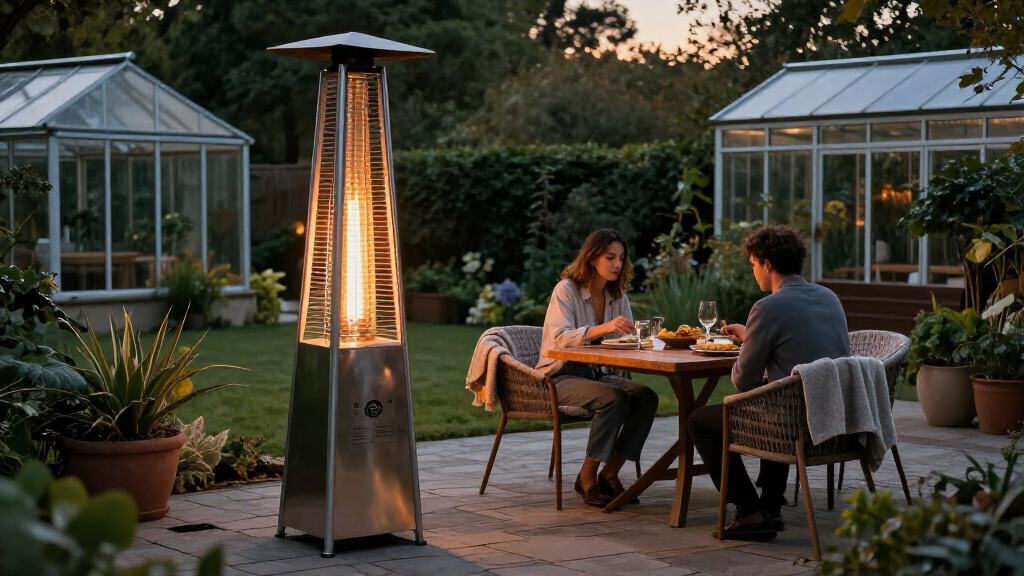
Choosing an outdoor patio heater comes down to a practical tradeoff: propane models bring heat where you need it and work without an electrical outlet, while electric models offer simpler operation and can warm people directly without an open flame. The difference matters most when you consider your patio’s exposure, access to power, and how often you want to move or maintain the heater. Propane is usually the better fit for open spaces and flexible placement; electric is often the easier choice for a sheltered patio with a suitable outlet or planned installation.

Get garden gear delivered free with Prime
- Fast, free delivery on millions of items
- Prime Video, Amazon Music and more included
- Member-only deals all year

Sweetcrispy 48,000 BTU Propane Patio Heater with Wheels and Table
- ✔ Heat output: 48,000 BTU
- ✔ Fuel: Propane
- ✔ Heating method: Radiant

hykolity 38.5-Inch 1500W Infrared Patio Heater
- ✔ Power: 1,500 watts
- ✔ Heating method: Radiant infrared
- ✔ Heating elements: Dual carbon tubes

SEEYANG 1500W Portable Electric Heater
- ✔ Power: 1,500 watts
- ✔ Heating technology: PTC ceramic with high-speed fan
- ✔ Modes: 25 W natural air, 750 W low heat, 1,500 W high heat
At a Glance
| Criteria | Propane patio heaters | Electric patio heaters | Winner |
|---|---|---|---|
| Heat delivery and outdoor performance | Strong radiant heat; performance can suit open-air patios, though wind disperses warmth. | Radiant heat warms people and nearby surfaces; wind and distance still reduce comfort. | Depends |
| Coverage and placement | Portable units can be repositioned; heat generally spreads around the unit. | Fixed or plug-in models work best near the outlet or installation point; direction is more controllable. | A |
| Installation and setup | Usually minimal setup; requires a compatible propane cylinder and safe placement. | Plug-in versions are simple; hardwired or overhead models may need professional installation. | B |
| Running costs and upkeep | Fuel must be replenished; costs depend on local propane prices and use. | No fuel-cylinder replacement; electricity use and installation affect ongoing cost. | Depends |
| Safety and operating limits | Open flame and hot surfaces require clearance, supervision and careful cylinder handling. | No combustion at the heater, but hot elements and electrical exposure still require care. | B |
| Weather and long-term use | Outdoor units need protection from harsh weather and routine inspection. | Outdoor-rated models can serve covered patios; weather rating and installation location matter. | Depends |
| Purchase value | Worth paying for when portability and outlet-free operation matter. | Worth paying for when easy controls, targeted warmth and less fuel handling matter. | Depends |
Sweetcrispy 48,000 BTU Propane Patio Heater with Wheels and Table
For a patio where several people sit at different spots, the Sweetcrispy’s 48,000 BTU propane output and stated coverage up to an 18-foot diameter give it the strongest case in this lineup. That makes it a more natural choice for a dinner table or a group gathered outdoors than either 1,500-watt electric model, whose listed specs do not claim comparable area coverage. Its radiant heat is intended to warm people and nearby surfaces, while the built-in round table adds a practical landing place for drinks or small items.Its mobility and safety details suit changing patio arrangements: wheels help reposition the tall unit, and ground anchors provide a way to secure it. The listing also specifies a flame-out shutoff and a tilt sensor that activates beyond 45 degrees. Those features do not remove the need to place and operate the heater carefully, but they are useful considerations for a tall outdoor appliance. Compared with the hykolity, we get more stated output and freedom from an electrical cord; compared with the SEEYANG, we get a design aimed at warming a wider gathering rather than one nearby person.The tradeoff is footprint and fuel. At 87 inches tall, it needs more storage clearance than either electric option, and propane means keeping fuel available and accommodating the cylinder. Buyers with a small balcony, limited storage, or a preference for outlet-powered equipment may find the hykolity easier to live with. We would choose the Sweetcrispy when the patio area and group size justify its scale.
Pros:
- 48,000 BTU output with stated coverage up to an 18-foot diameter
- Wheels support repositioning around an outdoor seating area
- Built-in side table adds a convenient surface
- Flame-out shutoff, tilt sensor, and ground anchors are specified
Cons:
- Requires propane fuel and the related storage and replenishment
- 87-inch height can make storage difficult
Best for: Households warming a larger outdoor seating area or gathering where propane is practical and storage can accommodate a tall heater.
Not ideal for: Small balconies, buyers without room to store an 87-inch unit, or anyone who wants an electric heater without propane handling.
Bottom line: We rank it first for patios that need broad, untethered heat and can accommodate its height and propane requirements.
“We rank it first for patios that need broad, untethered heat and can accommodate its height and propane requirements.”
hykolity 38.5-Inch 1500W Infrared Patio Heater
The hykolity is the most control-oriented electric option here. Its dual carbon infrared tubes have two heat settings, and a remote plus a 0–24-hour timer make it convenient when we want to adjust heat from a chair or set a limited operating window. Against the SEEYANG, that is a better fit for a patio seat where the heater can stay in one place; against the Sweetcrispy, it trades high stated BTU output and cord-free placement for electric operation and a more compact pedestal form.At 1,500 watts, we should think of it as a localized heater rather than a solution for evenly warming a large, open patio. The infrared approach is relevant outdoors because it directs warmth toward nearby people, but wind and distance still affect comfort. Its IP44-rated housing, tip-over shutoff, and overheat protection add practical reassurance for an outdoor-rated unit, while the listing also describes indoor and outdoor use. Electrical access remains essential, so we need to plan where the cord and outlet will be in relation to chairs and walkways.There is a fit question to resolve before choosing it: the title says 38.5 inches, but the listed dimensions are 41.54 × 11.81 × 7.68 inches and are labeled D × W × H. That inconsistency makes it harder to judge its true footprint or height alongside the SEEYANG, whose own dimensions also conflict. We would favor the hykolity over the portable fan heater when remote control and timed operation matter more than carrying convenience, but confirm the actual size with the seller if placement is tight.
Pros:
- Dual carbon infrared tubes with two heat settings
- Remote control and timer adjustable from 0 to 24 hours
- IP44-rated housing is specified for outdoor use
- Tip-over shutoff and overheat protection
Cons:
- Requires an AC power source and practical cord placement
- 1,500-watt output is better suited to localized warmth than broad coverage
- Title and dimension listing are inconsistent
Best for: Patio users with a nearby AC outlet who want a stationary electric heater with remote controls, two settings, and a timer.
Not ideal for: Large open patios, cord-free setups, or buyers who need confirmed dimensions before planning a tight placement.
Bottom line: We recommend it for a powered seating zone where remote operation and a timer are more useful than broad, propane-fueled coverage.
“We recommend it for a powered seating zone where remote operation and a timer are more useful than broad, propane-fueled coverage.”
SEEYANG 1500W Portable Electric Heater
Where the hykolity is built around a pedestal, remote, and timer, the SEEYANG is the portable, carry-by-the-handle option. It offers natural air, 750-watt low heat, and 1,500-watt high heat, so we can switch between airflow and two levels of warmth. The listing says it produces warm airflow in about two seconds; that quick-start design is most relevant when we want a personal heater for a covered or sheltered spot, rather than a central source for a full patio.Its compact form and three modes give it a different role from the Sweetcrispy’s large propane footprint. The Sweetcrispy is the better match for a group spread around a table, while the SEEYANG is easier to carry between a patio and indoor spaces, as its indoor/outdoor description suggests. The hykolity is a stronger alternative when we want infrared heat, remote operation, and timed control from a fixed position. With the SEEYANG, we get simple mode selection and portability, but still need an AC outlet and should not expect 1,500 watts to warm a broad, exposed area.The listing describes the heating technology as PTC ceramic and calls the method radiant, while also specifying a high-speed fan. We should therefore read its warm-air claim as a cue to close-range comfort rather than assume the same outdoor feel as a radiant patio tower. It includes overheat shutoff, V-0 flame-retardant material, and ETL certification. One practical uncertainty remains: dimensions appear as 6 × 8 × 15 inches in one place and 1 × 1 × 1 inches in another. That conflict, combined with its limited output for open spaces, makes it a flexible secondary choice rather than our main patio heater.
Pros:
- Three modes: natural air, 750-watt low, and 1,500-watt high
- Carrying handle supports moving it between locations
- Listing claims warm airflow in about two seconds
- Overheat shutoff, V-0 flame-retardant construction, and ETL certification
Cons:
- AC power is required, and output is limited for large or open outdoor areas
- Conflicting dimensions make its actual footprint uncertain
Best for: Buyers who want a small, movable heater for close seating, a sheltered patio nook, or occasional movement between indoor and outdoor spaces.
Not ideal for: Anyone trying to warm a large, exposed patio or seeking a cord-free heater with broad area coverage.
Bottom line: We see it as the most portable choice for nearby warmth, with too little stated output to replace the Sweetcrispy across a broad patio.
“We see it as the most portable choice for nearby warmth, with too little stated output to replace the Sweetcrispy across a broad patio.”
As an Amazon Associate we earn from qualifying purchases.
Key Differences
The clearest difference is freedom of placement. A propane heater can serve a seating area far from the house or move between patio zones, provided the surface is stable and the required clearances are maintained. An electric heater depends on a suitable outlet or a planned installation, but once in place it can direct warmth toward a specific table or seating area. For a large, open patio, propane’s mobility often outweighs the inconvenience of managing fuel. For a covered area where people sit in a consistent spot, electric heat is often easier to live with.
Neither type makes every outdoor space feel uniformly warm. Wind carries heat away, and effective coverage depends on the heater’s design, output, mounting height and distance from people. Electric radiant models can feel comfortable when aimed at occupants, while propane units can deliver broad warmth around the heater. Running cost also depends on local energy prices and hours of use, so there is no universal cost winner. Compare the maker’s consumption or power specifications with local fuel and electricity rates before buying.
Safety and installation can settle the choice. Propane requires cylinder storage and careful handling, plus outdoor placement with proper clearance from walls, awnings and combustible materials. Electric models avoid fuel storage and combustion, but outdoor use still calls for a unit rated for its location and suitable electrical protection. A hardwired installation can raise the initial cost; a plug-in model is simpler only if the outlet and cord arrangement are appropriate. Choose around the conditions of the actual patio, rather than assuming either heater works anywhere outdoors.
Detailed Comparison
Heat delivery and outdoor performance (moderate difference)
Neither option defeats wind or makes an exposed patio uniformly warm. Propane often suits open-air use because portable units can provide broad radiant warmth around a seating area. Electric radiant heaters can feel more targeted when aimed toward people, especially in a sheltered space. The winner depends on exposure and layout: this is a moderate difference, not a guarantee of a particular temperature or coverage.
Coverage and placement (Propane patio heaters wins — major)
Propane wins for placement flexibility: it can be moved to different seating areas without routing a power cord, subject to safe clearances and handling. Electric models work best where an outlet or fixed installation is available, but their directional warmth can suit a defined seating zone. The gap is major for patios far from power and minor for a small, permanently arranged space.
Installation and setup (Electric patio heaters wins — moderate)
Electric plug-in models are generally simpler to start using when the right outdoor outlet is already available, and overhead units can keep floor space clear once installed. Hardwired models may require an electrician. Propane avoids wiring but needs a cylinder, stable placement and safe clearances. Electric has a moderate advantage in routine setup when power access is ready; a new electrical installation can erase it.
Running costs and upkeep (moderate difference)
There is no dependable winner without local fuel and electricity rates, the heater’s consumption and expected hours of use. Propane owners need to refill or replace cylinders and check connections; electric owners avoid fuel handling but pay for electricity and may face installation costs. The difference is moderate because frequent use magnifies operating costs, while occasional use makes convenience more important.
Safety and operating limits (Electric patio heaters wins — moderate)
Electric wins for avoiding combustion and cylinder storage, which removes two specific handling concerns. It still produces heat and requires an outdoor-rated unit, proper electrical protection and careful placement. Propane adds an open flame and fuel cylinder, so clearance, ventilation, supervision and correct cylinder handling matter. The gap is moderate: neither type is risk-free, but electric reduces fuel-related tasks.
Weather and long-term use (moderate difference)
Neither category automatically withstands rain, wind or winter storage. Electric heaters must be rated for their exposure and installed according to the manufacturer’s instructions; propane units also need weather-aware placement and protection when stored. The winner depends on the specific unit and whether the patio is covered. This is a moderate difference decided by ratings and installation, not by fuel type alone.
Purchase value (moderate difference)
Propane is better value when mobility and operation away from outlets prevent costly wiring or let one heater serve several areas. Electric can justify a higher installed price when it offers convenient, targeted warmth in a regular seating spot and avoids cylinder management. Compare full ownership costs for your use pattern; the difference is moderate and depends on the patio as much as the product.
Propane patio heaters: Pros and Cons
Pros:
- Works without an electrical outlet and can move between suitable patio zones.
- Often a practical fit for open patios where portability matters.
- Does not require wiring or a permanent mounting point.
Cons:
- Requires cylinder supply, storage and handling.
- Open flame and hot surfaces call for careful placement and supervision.
- Wind can disperse warmth, and fuel costs vary by location.
Electric patio heaters: Pros and Cons
Pros:
- Avoids propane cylinders and combustion at the heater.
- Radiant models can direct warmth toward a defined seating area.
- Plug-in use can be straightforward when a suitable outdoor outlet is available.
Cons:
- Placement depends on outlet access or installation; hardwired units can add cost.
- Electrical use adds to the bill, with costs varying by rates and runtime.
- Outdoor exposure requires an appropriately rated unit and setup.
Who Should Choose What
Choose Propane patio heaters if:
- Your patio is open, distant from outlets, or arranged so the heater needs to move between seating areas.
- You want heat without installing electrical equipment and are comfortable managing propane cylinders.
- You need one heater to serve different outdoor zones across the week.
Choose Electric patio heaters if:
- Your seating area stays in one place and has a suitable outdoor outlet or a practical mounting location.
- You prefer avoiding fuel storage and want simple, targeted radiant warmth.
- You are willing to pay for electrical installation when it makes frequent use easier.
Skip both if: Skip both if the space is too exposed to make a heater useful, or if you cannot meet the unit’s clearance, ventilation, weather-rating or electrical requirements.
Value for Money
Pay more for propane when its portability solves a real constraint, such as a patio without nearby power or multiple seating zones. Its value falls if you use it rarely or dislike buying and storing cylinders. Pay more for electric when a sheltered, regular seating area makes targeted heat convenient and you want to avoid fuel handling. A hardwired installation only makes financial sense if the expected use justifies the upfront work. Before choosing, compare the unit’s stated fuel consumption or electrical draw with local rates and your likely hours of use; sticker price alone does not show the better value.
Final Verdict
For most open patios without convenient power, choose propane: its mobility and outlet-free operation solve the main practical problem. Choose electric for a sheltered patio with a fixed seating area and suitable power, especially if avoiding cylinder handling matters more than moving the heater. The deciding factor is placement: buy propane when you need freedom from wiring, and electric when power access and targeted warmth make everyday use simpler. Neither is a good choice if the patio cannot meet the model’s safety or weather requirements.
Frequently Asked Questions
Which patio heater works better in an open, windy space?
Neither works as well in strong wind because moving air carries warmth away. Propane may be more practical when the heater needs to move to follow a seating area, but check the manufacturer’s guidance for wind and outdoor use. A sheltered location generally helps more than switching fuel types.
Is propane or electric cheaper to run?
It depends on local propane and electricity prices, the heater’s consumption and how long you use it. Compare the product specifications with your local rates and expected runtime. Include cylinder refills for propane and any electrical installation cost for a hardwired model.
Can I use an electric patio heater under a covered patio?
Only if the specific heater is rated for that location and its installation instructions allow it. Follow the required clearances from ceilings, awnings and combustible materials, and use appropriate outdoor electrical protection. A covered space does not automatically make an indoor-rated heater suitable.
Is a propane patio heater safe near a table or awning?
Use it only where the manufacturer’s clearances can be met, with stable placement and suitable ventilation. Keep it away from combustible materials and follow the instructions for cylinder handling and storage. If the patio layout cannot provide the required space, choose another heating arrangement.