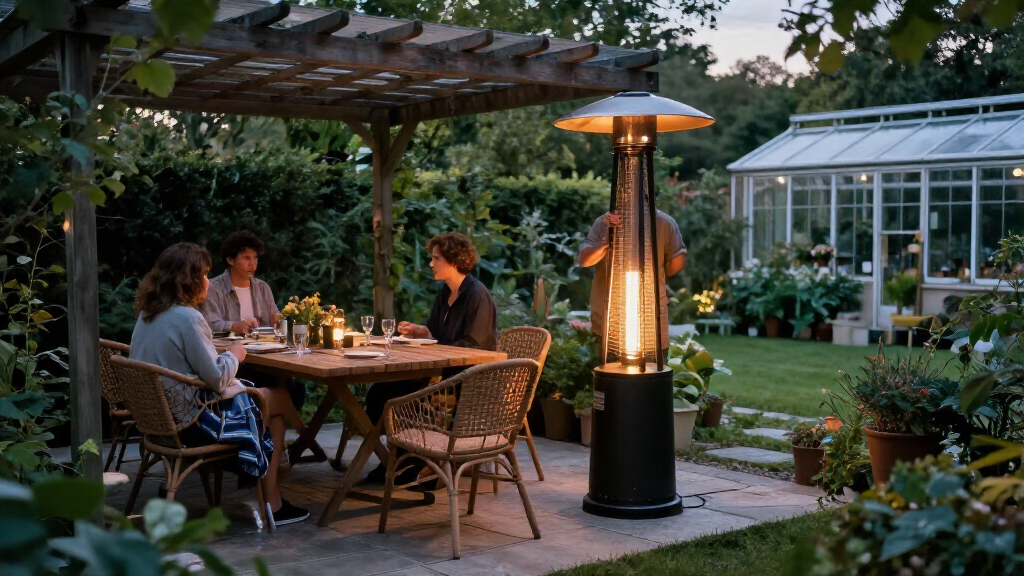

Choose and set up an outdoor patio heater so it warms your seating area without creating avoidable fire, burn, or carbon monoxide risks. This guide is for homeowners and renters with a patio or other outdoor seating space; no heater installation experience is assumed. Allow 30-60 minutes to assess the space, review the heater instructions, and set up a portable unit. Permanent gas or electrical installation may take longer and require a qualified professional.

Get garden gear delivered free with Prime
- Fast, free delivery on millions of items
- Prime Video, Amazon Music and more included
- Member-only deals all year

Sweetcrispy 48,000 BTU Propane Patio Heater with Wheels and Table
- ✔ Heat output: 48,000 BTU
- ✔ Fuel: Propane
- ✔ Heating method: Radiant

hykolity 38.5-Inch 1500W Infrared Patio Heater
- ✔ Power: 1,500 W
- ✔ Heating method: Radiant infrared
- ✔ Heating elements: Dual carbon tubes

SEEYANG 1500W Portable Electric Heater
- ✔ Power: 1,500 W
- ✔ Modes: 25 W natural air; 750 W low; 1,500 W high
- ✔ Heating technology: PTC ceramic
Difficulty: Beginner | Time: 30-60 minutes for selection and setup
What You’ll Need
Tools & Materials:
- Tape measure
- Heater manufacturer’s manual
- Outdoor-rated extension cord only if the manual permits one
- For a propane model: the specified propane cylinder and a leak-detection solution approved for gas connections
Knowledge:
- Basic ability to measure a patio and identify nearby doors, windows, roof coverings, and combustible materials
- Ability to read the heater’s fuel, clearance, and operating instructions
Check local fire codes, building rules, and the heater’s listing before buying or operating it. Patio heaters vary by fuel, output, required clearances, and permitted locations. Follow the manufacturer’s instructions and any stricter local requirements. Never use an outdoor combustion heater inside an enclosed or partly enclosed space.
Sweetcrispy 48,000 BTU Propane Patio Heater with Wheels and Table
For a patio where people gather across a wider area, the Sweetcrispy’s 48,000 BTU output and stated coverage up to an 18-foot diameter give it a clear advantage over the two 1,500 W electric options. That makes it the most convincing pick here for open-air seating where a single compact electric heater may struggle to spread warmth. Its propane fuel source also avoids the need to keep the heater beside an AC outlet, though it means planning for a fuel tank.The built-in round table, wheels, and ground anchors make the tall heater more patio-oriented than a bare heat source: the table offers a place for small items, and the wheels help with repositioning. Safety features include flame-out shutoff and a tilt sensor that activates beyond 45°. Those details add useful safeguards, but they do not make the unit small or effortless to store. At 87 inches tall, it needs considerable storage space, and its propane requirement adds ongoing setup work. Compared with hykolity, it is better suited to broad outdoor coverage than precise plug-in convenience; compared with SEEYANG, it is a substantial stationary-style choice rather than a portable spot heater.
Pros:
- 48,000 BTU output with stated coverage up to an 18-foot diameter
- Propane operation does not require an AC outlet beside the heater
- Flame-out shutoff and tilt sensor are included
- Wheels, ground anchors, and a built-in round table support patio use
Cons:
- Requires propane fuel and the related tank setup
- Its 87-inch height makes storage more demanding
- Larger and less convenient to move or store than either electric pick
Best for: People furnishing a larger open patio who want high stated output, propane-powered placement flexibility, and a heater with wheels and a small built-in table.
Not ideal for: Patio owners with limited storage, no interest in handling propane, or a compact covered seating nook that needs a smaller heater.
Bottom line: We recommend Sweetcrispy for larger open patios where stated coverage and freedom from a power cord matter more than compact storage.
“We recommend Sweetcrispy for larger open patios where stated coverage and freedom from a power cord matter more than compact storage.”
hykolity 38.5-Inch 1500W Infrared Patio Heater
Hykolity is the better match for buyers who want a plug-in electric heater with direct radiant warmth and useful controls. Its dual carbon heating tubes operate at two settings, while a remote and 0–24-hour timer make it easier to adjust or schedule use from a seat. Unlike the propane Sweetcrispy, it needs no fuel tank; unlike the small SEEYANG, its pedestal form and infrared approach are aimed at warming people and nearby seating rather than pushing hot air with a fan.The tradeoff is that 1,500 W depends on an AC outlet and is a different scale of output from Sweetcrispy’s 48,000 BTU. For a broad, exposed patio, the propane model is the stronger stated coverage choice. Hykolity’s IP44-rated housing, tip-over shutoff, and overheat protection add practical protections, but the provided information does not establish a specific coverage area. There is also a specification inconsistency: the title calls it 38.5 inches, while the listed dimensions are 41.54 × 11.81 × 7.68 inches. We would confirm the actual footprint before choosing a storage or placement spot.
Pros:
- Dual carbon tubes and two heat settings
- Remote control and adjustable 0–24-hour timer
- IP44-rated housing for its stated indoor and outdoor use
- Tip-over shutoff and overheat protection
Cons:
- Requires an AC power source and is limited to 1,500 W
- No specific patio coverage area is provided
- Title and listed dimensions conflict
Best for: People with an accessible outdoor outlet who want adjustable radiant heat, remote operation, and a timer for a defined patio seating area.
Not ideal for: Anyone heating a large open area without a nearby outlet, or shoppers who need dependable dimensions before planning a tight installation or storage space.
Bottom line: We’d choose hykolity for convenient electric radiant warmth near an outlet, provided its dimensions and the patio’s coverage needs are checked first.
“We’d choose hykolity for convenient electric radiant warmth near an outlet, provided its dimensions and the patio’s coverage needs are checked first.”
SEEYANG 1500W Portable Electric Heater
SEEYANG takes a different route from the other two: its PTC ceramic element and high-speed fan produce warm airflow, and the carrying handle makes the unit easier to move between spots. Three modes—natural air, 750 W low heat, and 1,500 W high heat—give it more flexibility for changing conditions than a heater with only a single output. For a small, sheltered seating area or occasional spot warmth, that portable format may be more useful than Sweetcrispy’s tall propane tower.For open patios, however, portability does not compensate for limited stated power. At 1,500 W, it is not the lineup’s choice for broad outdoor coverage; Sweetcrispy has far higher stated output, while hykolity is the more patio-focused radiant electric option with a pedestal and IP44 rating. SEEYANG’s fan-assisted warmth also differs from infrared radiant heat, so buyers should consider whether they want warm airflow near the unit or heat directed toward nearby people. The provided dimensions are inconsistent too: the description says 6 × 8 × 15 inches, while item details say 1 × 1 × 1 inch. We would verify size before relying on it for a particular storage space.
Pros:
- Three modes: natural air, 750 W low, and 1,500 W high
- PTC ceramic heating with fan-assisted warm airflow
- Carrying handle supports moving it between nearby spots
- Overheat shutoff, V-0 flame-retardant material, and ETL certification are listed
Cons:
- 1,500 W output may be limited in open or large outdoor areas
- Requires an AC outlet
- Description and item details give conflicting dimensions
Best for: People who want a portable electric heater for a small, sheltered patio nook and value multiple modes and a carrying handle.
Not ideal for: Anyone trying to warm a large, exposed patio or seeking a clearly specified outdoor coverage area.
Bottom line: We’d pick SEEYANG for portable, localized warmth in a modest sheltered area, not as the main heater for an expansive patio.
“We’d pick SEEYANG for portable, localized warmth in a modest sheltered area, not as the main heater for an expansive patio.”
As an Amazon Associate we earn from qualifying purchases.
Before You Start
Decide how many people and what seating area need heat. Check whether the patio is truly open to outdoor air: a roof, walls, screens, or windbreaks can affect ventilation and clearances. Do not assume an outdoor heater is safe beneath an awning or inside a screened porch. Confirm that the specific model is approved for the intended location. If you cannot meet its clearances or keep the heater stable, choose another position or a different type of heater.
Compare fuel options before purchasing. Propane and natural gas heaters produce combustion gases and need the open-air conditions specified by the maker. Electric heaters avoid combustion at the unit but still need a suitable outdoor-rated power source and protection from water as specified on the product. A hardwired electric or fixed gas unit may require professional installation.
Step-by-Step Instructions
Step 1: Measure the seating area
Measure the patio and mark where people will sit. Note the distance to walls, furniture, plants, fabric, roof edges, and traffic paths. Decide whether you need heat for one table or a larger zone; a single portable heater may not warm a broad area evenly.
Tip: Use the heater’s stated coverage as a starting point, not a guarantee. Wind, open sides, and cold temperatures can reduce the area that feels warm.
Check: You have a measured seating zone and know where a heater could stand without blocking a walkway.
Step 2: Choose a heater suited to the site
Compare heaters by fuel, approved location, heat output, coverage, stability, and operating cost. Check the manufacturer’s clearance requirements and whether the unit is designed for freestanding or wall-mounted use. Select a model that can be positioned within its required clearances and connect to an appropriate fuel or power source.
Tip: Do not choose by heat output alone. A powerful model that cannot be placed safely is not suitable for the patio.
Check: The heater instructions permit the intended location, and the fuel or electrical supply matches the model.
Step 3: Prepare a level, open position
Place the heater on a firm, level surface in the location permitted by its manual. Keep it away from doors, windows, air intakes, overhangs, and combustible items by at least the specified distances. Leave the required open space above and around the unit, and keep it out of the main walking route.
Tip: Never use a combustion heater in a garage, tent, enclosed porch, or other enclosed area. Carbon monoxide can build up even when a door or window is open.
Check: The heater stands upright, the surface does not wobble, and all required clearances are available.
Step 4: Connect the fuel or power source
For propane, use only the cylinder type and connection described in the manual. With the heater off, secure the cylinder in its designated holder and connect the regulator as instructed. If the manufacturer permits a leak check, apply an approved solution to the connection and watch for bubbles; never check for leaks with a flame. For electric models, use the outlet and circuit rating specified by the maker, protect connections as directed, and keep plugs and cords away from water and hot surfaces.
Tip: If you smell gas, hear a hiss, or see bubbles at a gas connection, do not ignite the heater or operate nearby switches. Shut off the supply if you can do so safely, move people away, and contact the gas supplier or emergency services according to local guidance.
Check: Connections are secure, no leak is indicated, or the electric unit is connected exactly as specified.
Step 5: Check controls and safety features
Locate the shutoff control, ignition control, and any tip-over or flame-failure protection. Read the lighting and shutdown sequence in the manual before starting. Keep children and pets away from the heater and mark a boundary that prevents contact with hot surfaces.
Tip: Do not bypass a safety switch or use a heater with damaged wiring, a cracked reflector, a bent pole, or a faulty gas hose.
Check: You can identify how to start and stop the heater and how to shut off its fuel or power.
Step 6: Start the heater as directed
Follow the manufacturer’s lighting or startup sequence exactly. Stand in the position specified, keep your face and hands clear of the burner, and do not lean over the unit. Let the heater run at the recommended setting, then check that the flame or heating element appears normal and that no nearby item is becoming hot.
Tip: If ignition fails, turn the unit off and wait for the time specified in the manual before trying again. Repeated attempts can allow unburned gas to collect.
Check: The heater starts without unusual noise, odor, smoke, or unstable flame, and its warmth reaches the intended seats.
Step 7: Monitor use and shut down safely
Stay near the operating heater and keep its clearance area clear. Do not move, cover, refuel, or leave the unit unattended while it is on or hot. When finished, use the manual’s shutdown sequence, close the fuel supply if instructed, and let the heater cool fully before covering, storing, or changing a cylinder.
Tip: Turn the heater off when wind makes it unstable or directs heat toward people, walls, fabric, or other materials.
Check: The heater is off, its fuel or power is isolated as directed, and it has cooled before storage or handling.
Common Mistakes to Avoid
- Placing the heater beneath a low roof, awning, or near a wall. — Measure the required side and overhead clearances from the manual before selecting the position. Use the heater only in locations the manufacturer approves.
- Using an outdoor combustion heater in a screened or enclosed space. — Use propane or natural gas models only in the open-air conditions stated by the manufacturer. Choose an approved electric model if the site does not meet those conditions.
- Using an unstable surface or leaving the heater where people can bump it. — Set the unit on level, firm ground and keep it out of walkways. Do not disable tip-over protection or improvise a stand.
- Refueling or moving a heater while it is hot or running. — Shut it down and let it cool fully before handling cylinders, repositioning, or storage.
Troubleshooting
Problem: The heater will not ignite.
Solution: Turn it off and follow the manual’s wait period before retrying. Check only the permitted items, such as the fuel supply, cylinder valve, battery, or electrical connection. Stop and contact the manufacturer or a qualified technician if it still fails; do not disassemble the burner or bypass a safety control.
Problem: The heater lights but produces little warmth.
Solution: Confirm that it is operating at the intended setting and that the seating area is within its stated coverage. Move seats closer only if they remain outside all required clearances. Wind can carry heat away; reposition the heater only if another safe, approved location is available.
Problem: The flame flickers, goes out, or behaves unusually.
Solution: Switch off the unit and close the fuel supply if safe. Let it cool, then check the manual for permitted checks such as a low cylinder or blocked air opening. Do not use it again if the problem persists, the flame is abnormal, or a gas odor is present.
Problem: The heater or its surroundings feel unstable or too hot.
Solution: Shut the heater down and keep people clear while it cools. Check the surface, clearances, and wind conditions against the manual. Do not resume use until the unit is stable and all nearby materials are outside the specified heat and clearance zones.
What Success Looks Like
The heater is approved for the patio location, stands securely on a level surface, and has the manufacturer’s required clearances. Its fuel or electrical connection matches the instructions, startup and shutdown controls work as described, and it heats the intended seating area without unusual odor, sound, flame, or excessive heating of nearby surfaces. The heater is shut off and cooled before anyone moves or stores it.
Next Steps
After the heater cools, inspect it for damage and store it according to the manual. Keep cylinders upright and stored only in an approved outdoor location, away from heat and ignition sources; follow local storage rules. Before each use, check the hose, cord, base, and surrounding clearance. Arrange servicing on the schedule the manufacturer gives, and stop using the unit if a safety feature fails or damage appears.
Frequently Asked Questions
Can I use a patio heater under a covered patio?
Only if the specific heater is approved for that setting and the roof height, side clearance, and ventilation meet its instructions and local rules. Do not assume that an open side or ceiling fan makes a combustion heater safe under a cover.
Which is better for a patio: propane or electric?
It depends on the site and the model. Propane units need a suitable cylinder and open-air placement. Electric units need an appropriately rated outdoor power source and protection from water as directed. Compare the approved location, coverage, installation needs, and running costs for the products available to you.
How close can people sit to a patio heater?
Follow the distances in the heater manual, including any clearance from the emitter, reflector, or sides. Heat output and model design vary, so a single distance does not apply to every heater.
Can I leave a patio heater on overnight?
No. Shut it off when the patio is no longer supervised, and follow the manufacturer’s shutdown and fuel-isolation instructions. Never leave a running heater unattended.